Content: Barbara Gutierrez
Research: Caitlin Nielson
Platform: Mobile Native, Mobile Web, Desktop
When: 2025-2026
Role: Lead Product Designer
PM: Limor Mazlin, Melody Chang, Haley Humes
Using Credit Karma data to personalize how members start in TurboTax
Millions of Credit Karma members sign in to TurboTax each season, and more than half leave at the very first screen. The opportunity was to use what Credit Karma already knows about each member to make that first experience feel built for them. I led tests on what the welcome screen should say, and found that leading with what members walk away with, instead of the discount, matched or beat discount-led welcomes on starts and beat them on completes across every surface. I also designed the sequences for Credit Karma’s first AI model that chose each member’s onboarding steps. It drove more starts but not more finished returns, so we moved traffic back to a simpler approach that routes members by predicted tax complexity before peak.
Context
Brand merger

Baseline experience
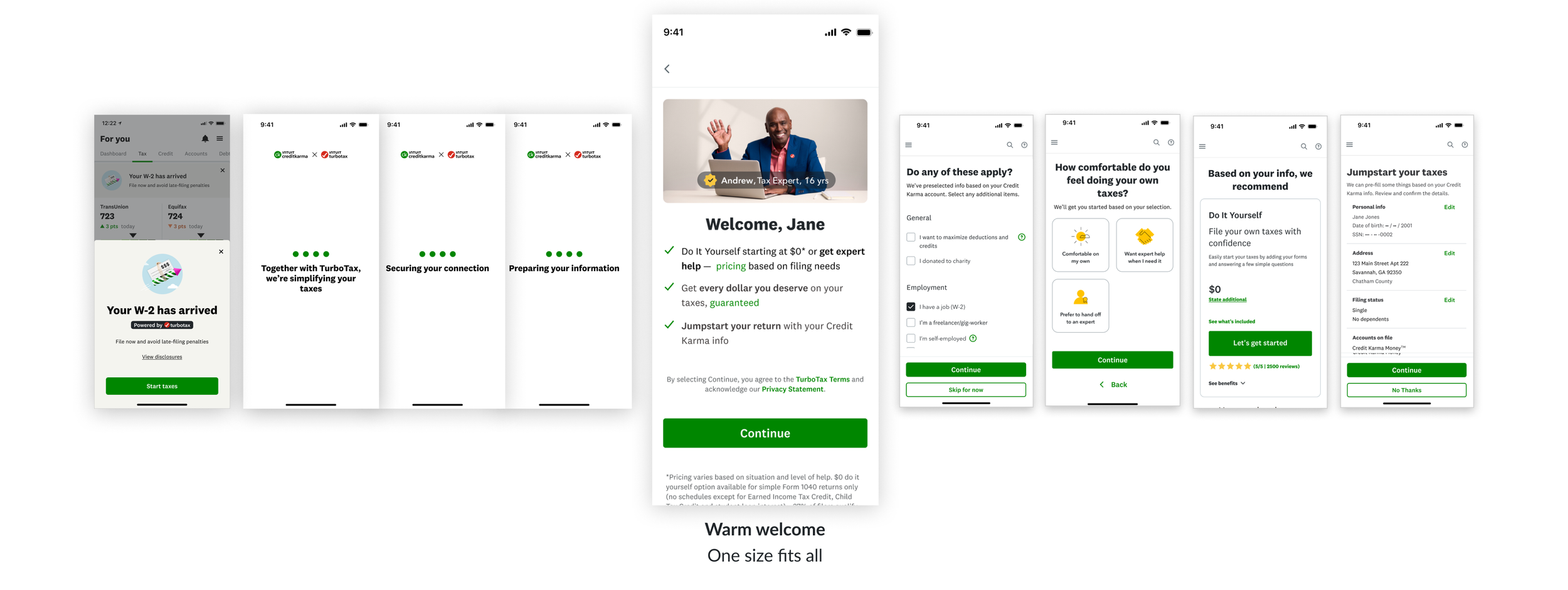
One size fits all
The core challenge lies in an intent gap:
CK members arrived with a 'check my score' mindset, but failing to transition that mindset into a tax-filing context.
I shifted the tax year 2025 strategy from a one-size-fits-all funnel to a hyper-personalized onboarding flow.
Planning
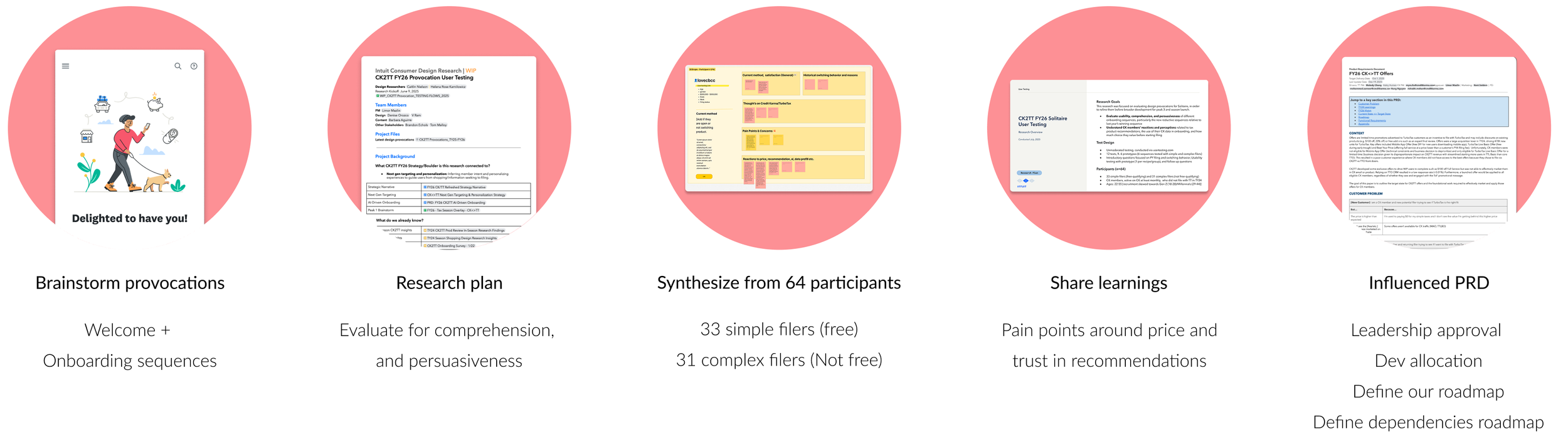
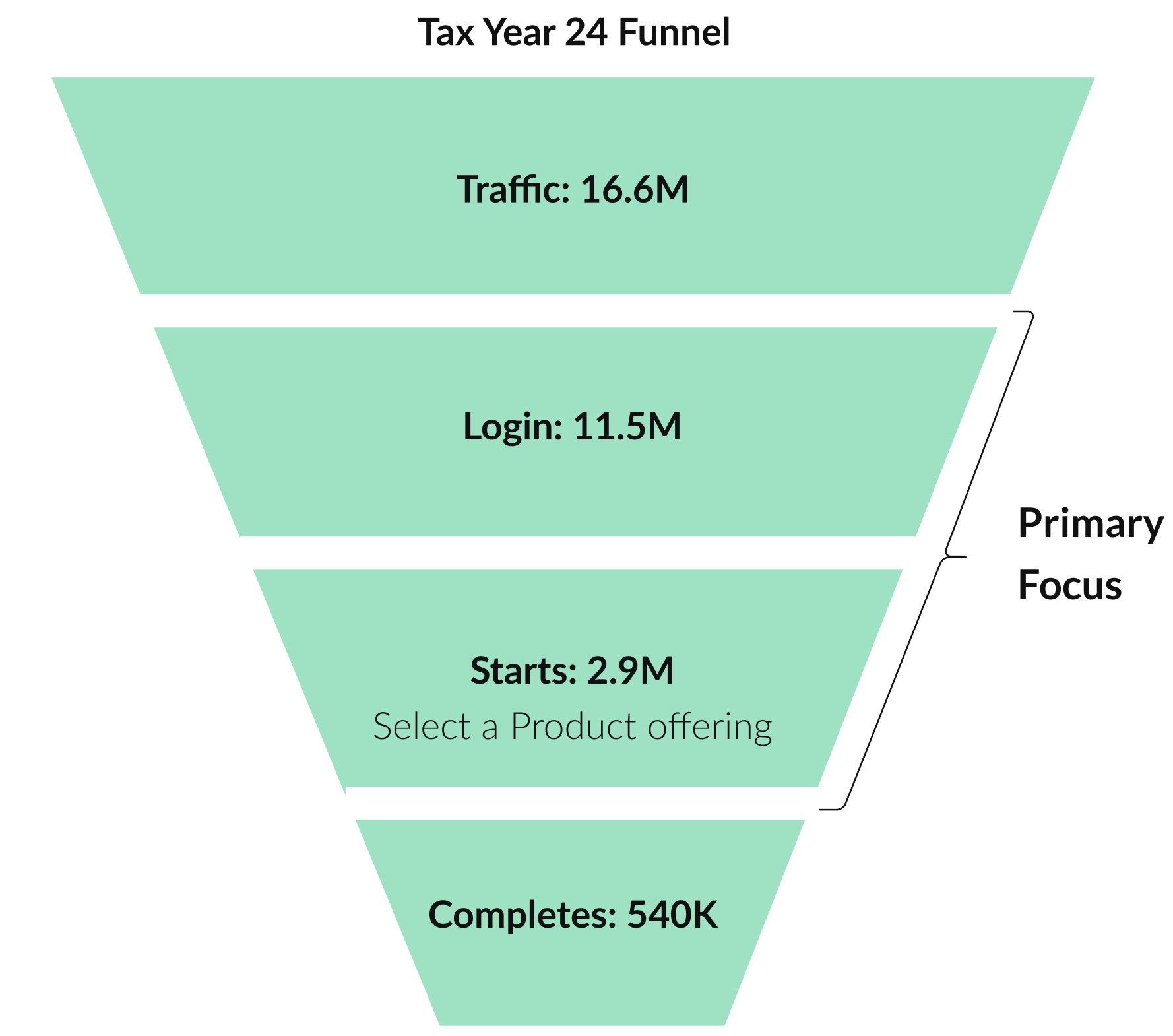
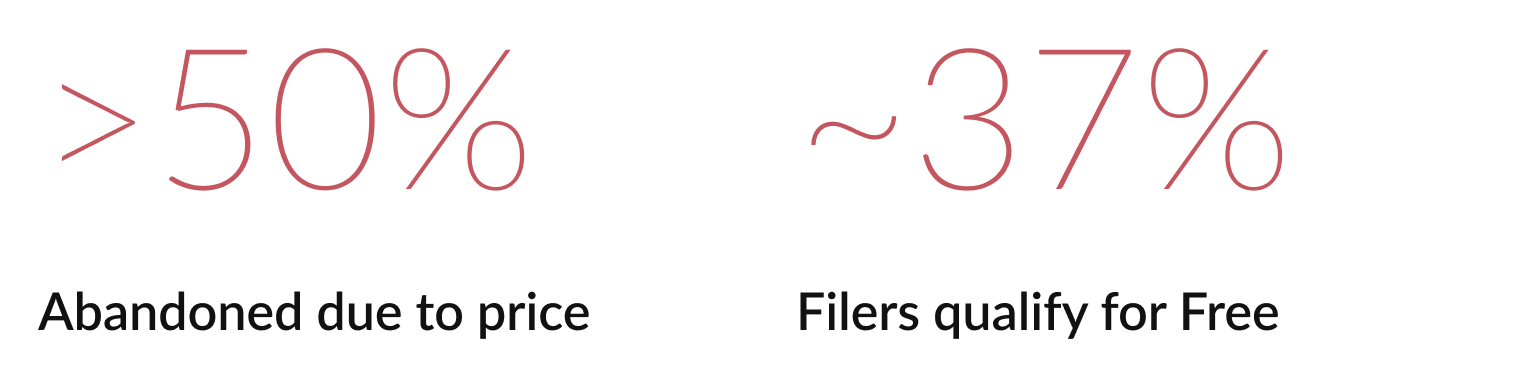
Going into the season, I had a mandate to build TurboTax's first AI-personalized onboarding experience, but no brief. Nobody had defined what "personalized" meant for a filer, or whether it was even the right lever. What I did have was a known problem: 50% abandonment at the landing page.
Without a brief, I used a simple method to decide what to do next: what do I know, what am I missing, what's the fastest way to close that gap, and what's my actual deadline. I had the abandonment data but not the why, so I ran an unmoderated study , 64 filers split between simple (free-eligible) and complex — fast enough to hit a hard deadline.

Hypothesis
If we use Credit Karma customer data to display targeted messaging, offers, and AI driven onboarding sequence that aligns with their needs
Then we will identify what drives the strongest activation and conversion
Because customers arrive with an unknown mix of price sensitivity and motivations.
Principles:
• Customer-Centricity
• Clear Message
• Best-in-class experience

Verbatim from Usertesting participants
Framing the problem
Abandonment driver #1
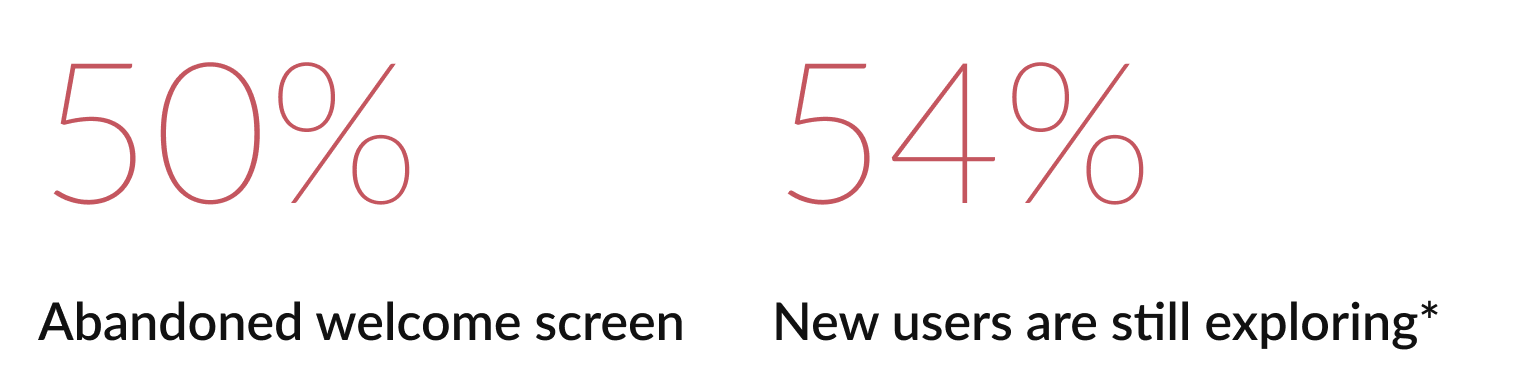
Of members who logged in to file, roughly 3 out of 4 abandoned before ever selecting a product — and half of that group left on the very first screen. Survey data showed why: most new users weren't ready to commit yet, they were still deciding whether to file at all. That insight shifted my focus upstream, from optimizing deeper in the funnel to rethinking what the entry point needed to accomplish first.
Strategic lever #1
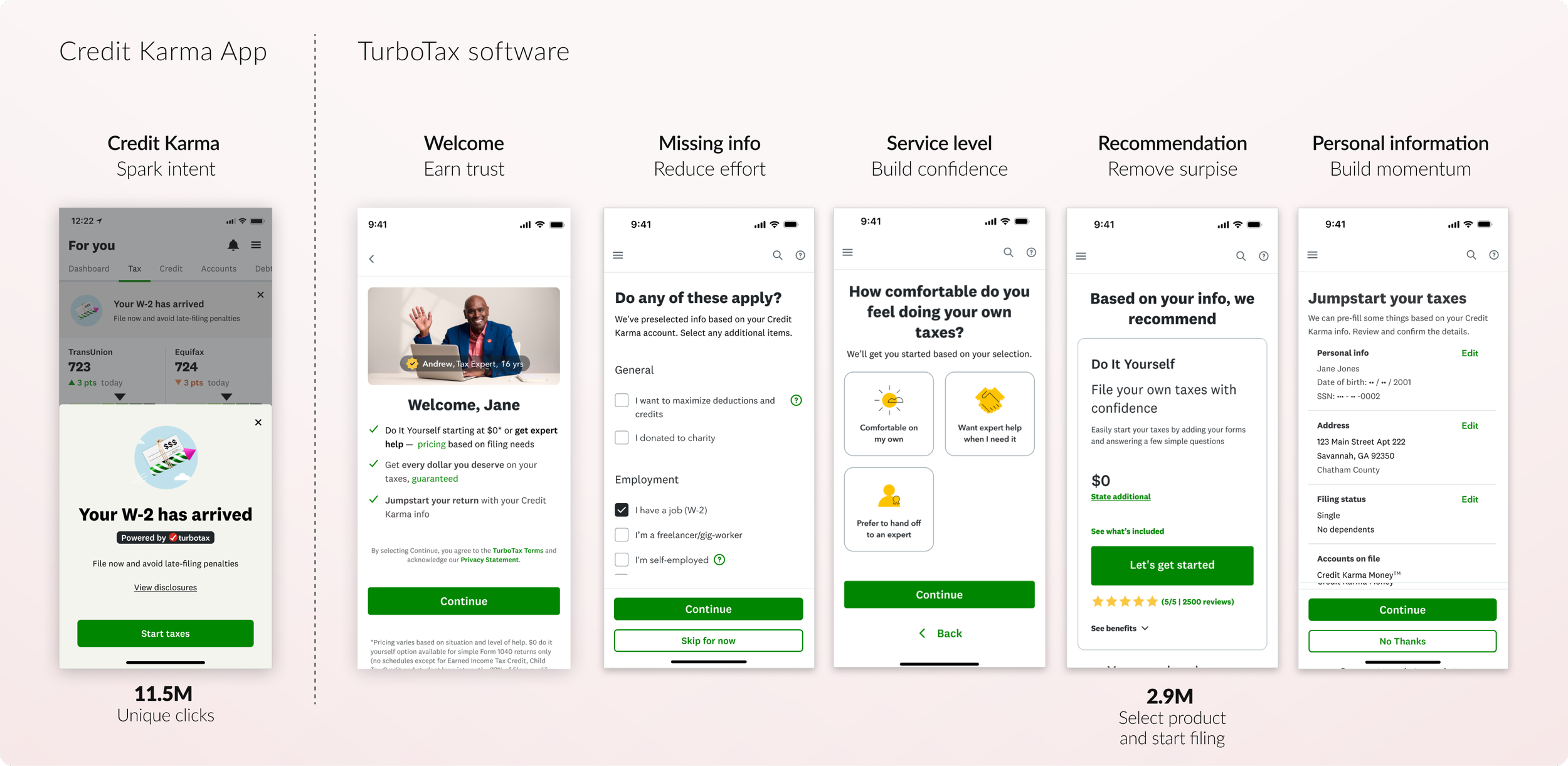
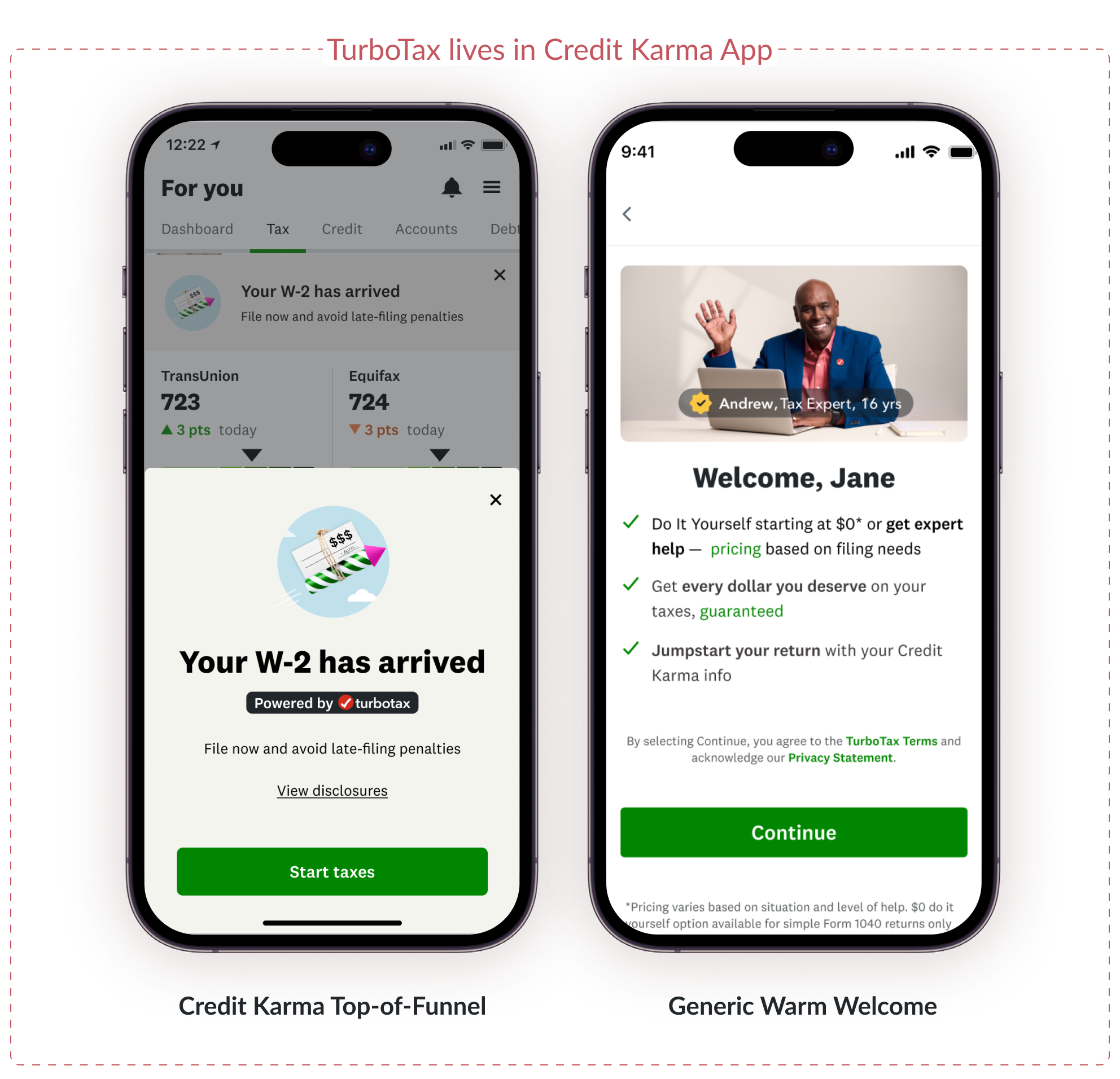
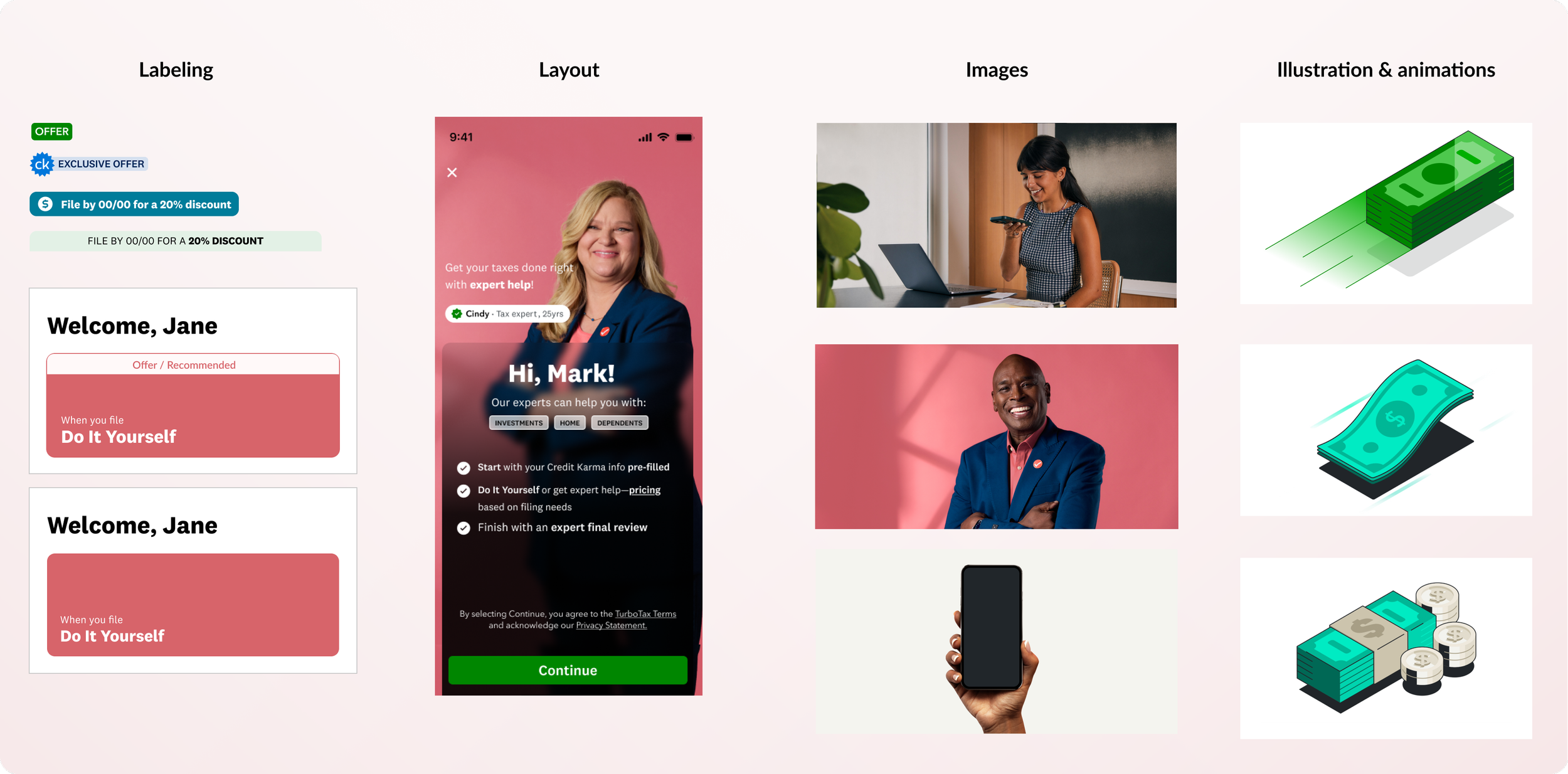
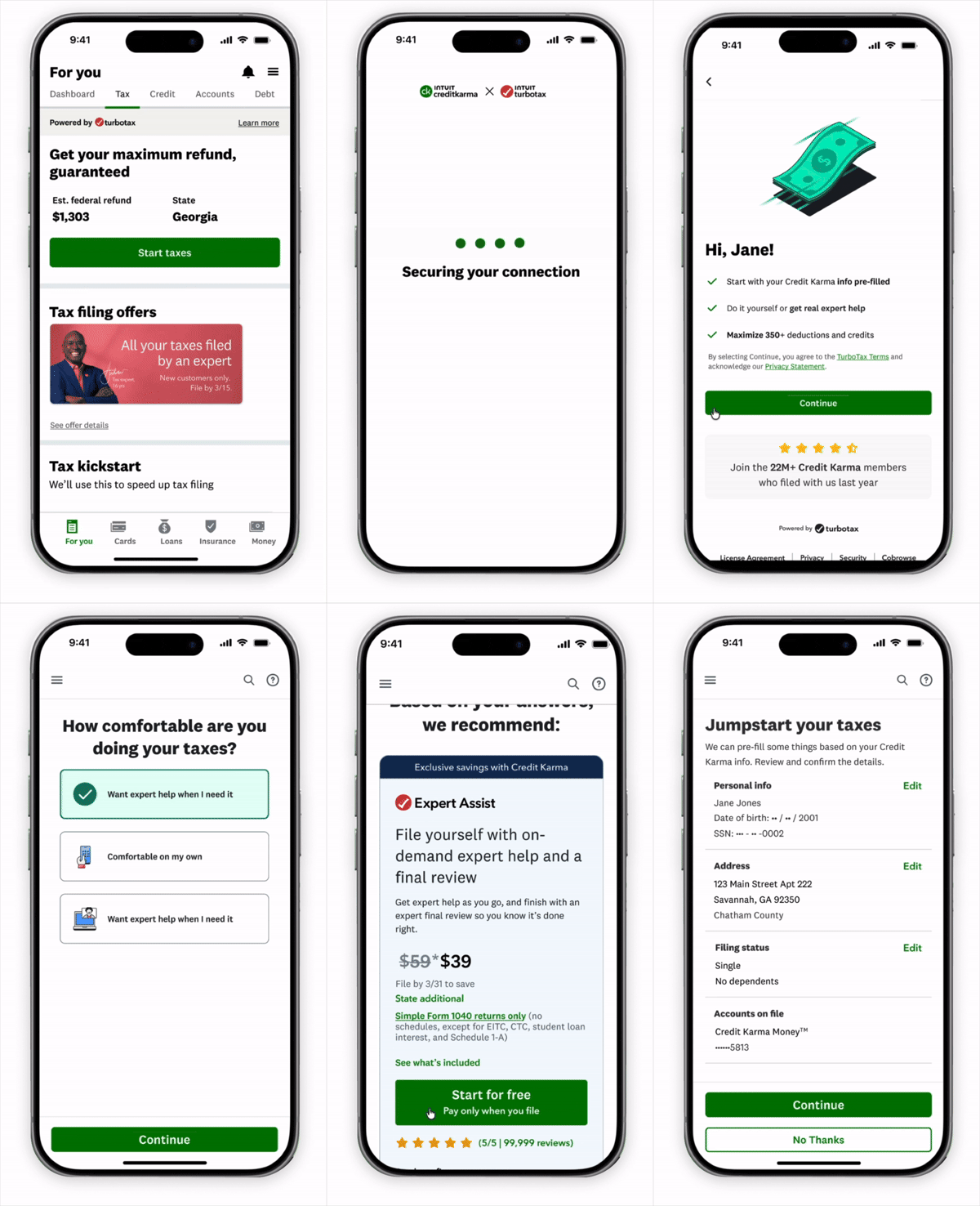
Since most abandonment happened before users were ready to commit, I proposed shifting the entry point from a generic welcome to one built on data Credit Karma already holds to make the first interaction feel personal.
Sources of data: Member Reported, Credit Bureau, TransUnion, CK Refund Estimator, TurboSnax.
Strategic lever #2
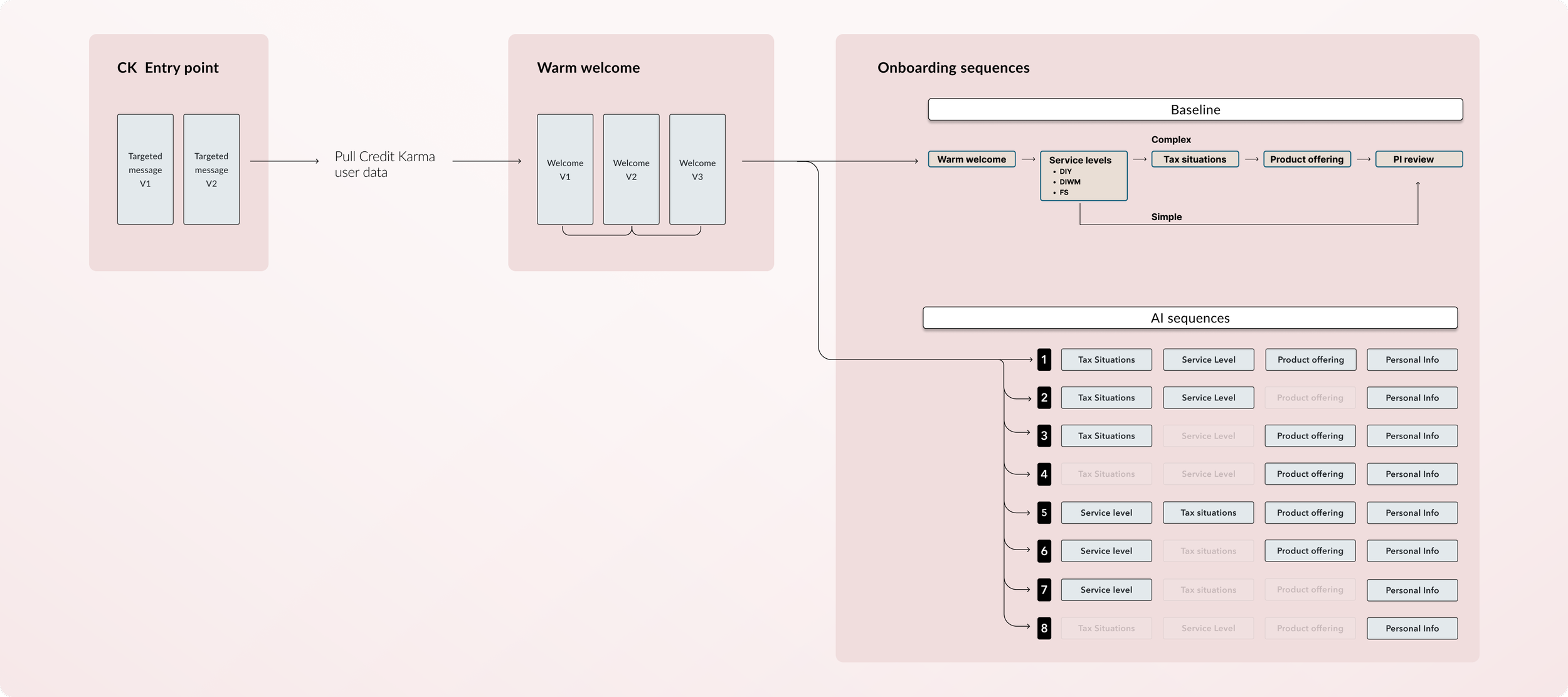
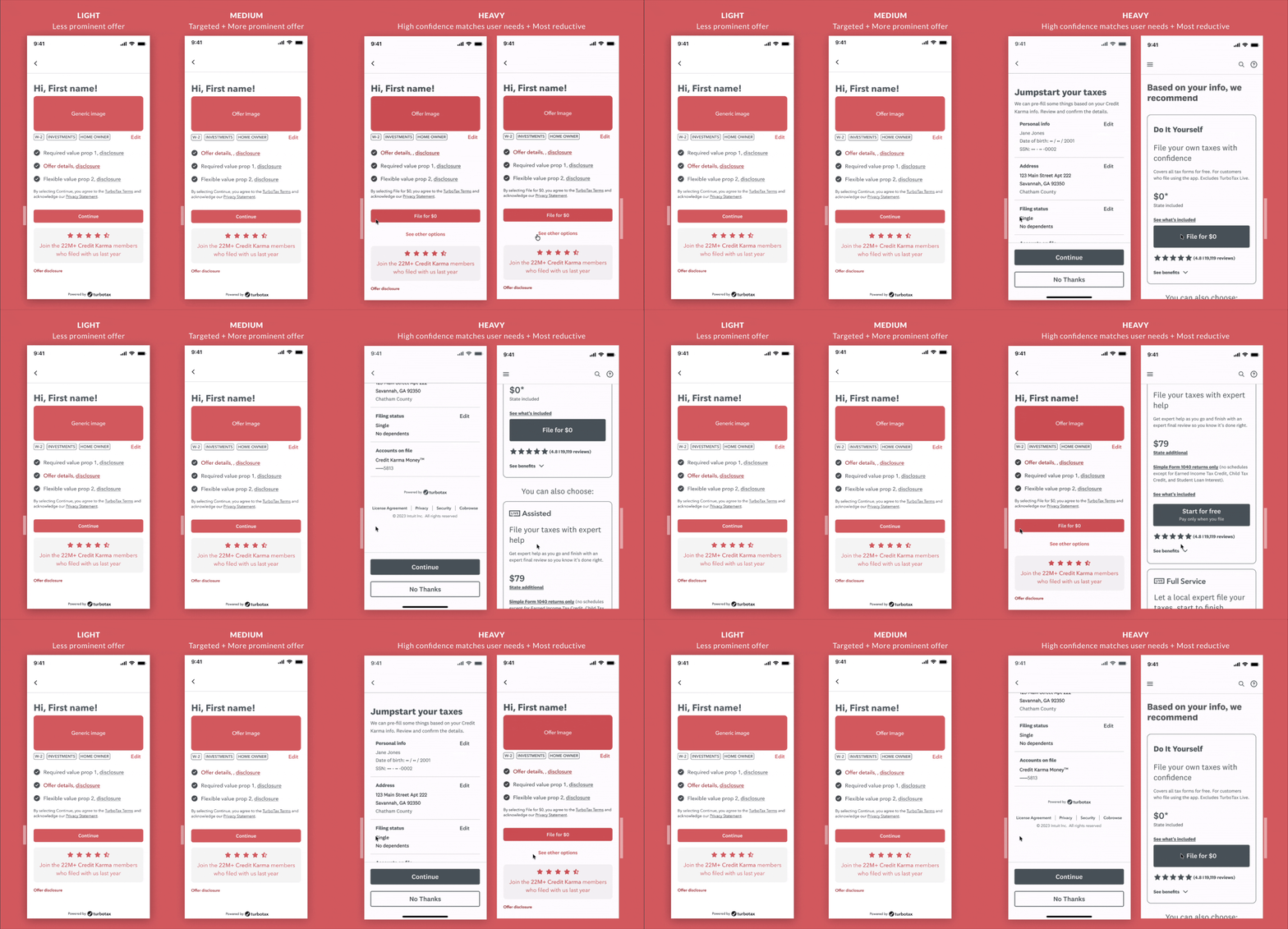
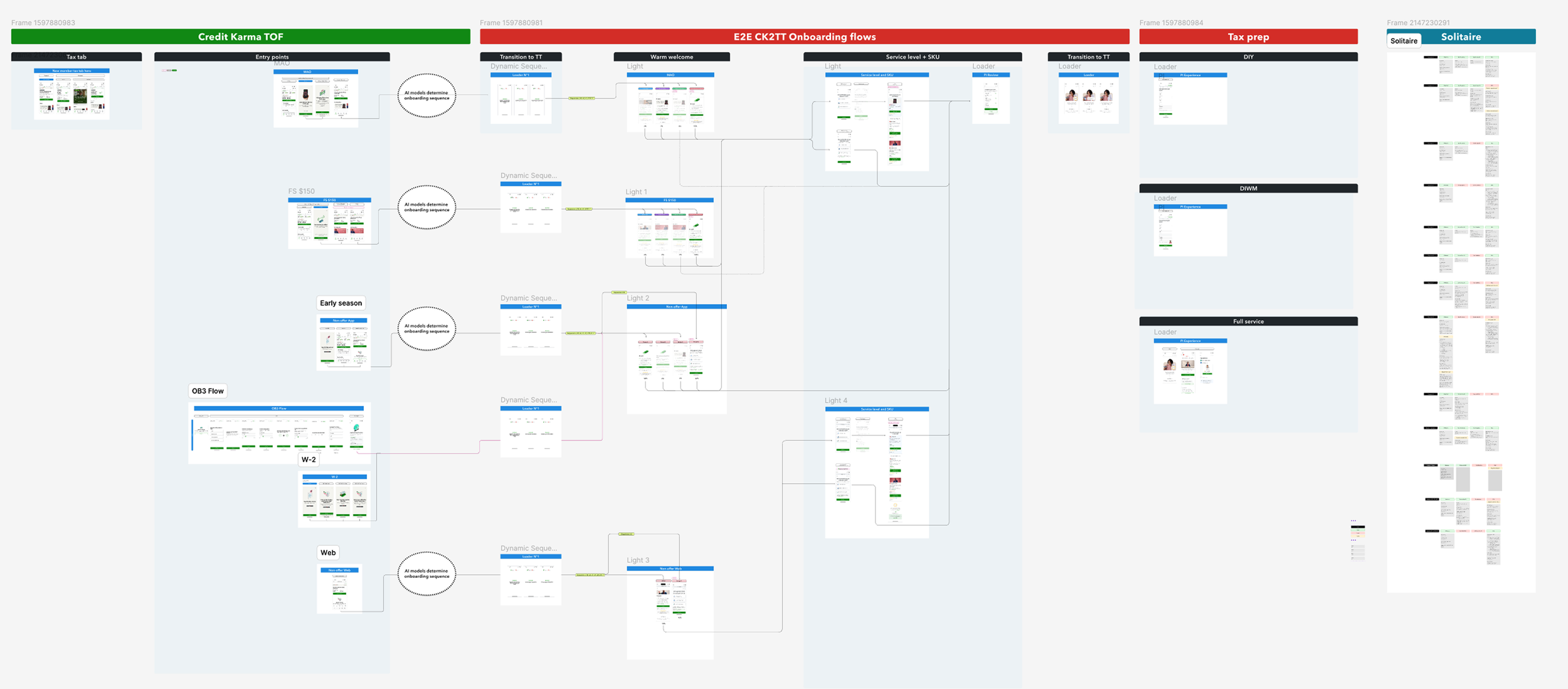
Last season’s best-performing onboarding followed fixed rules: people predicted to have complicated taxes saw extra steps, and everyone else got a shorter path. Rules like that can’t adjust for who someone is or when in the season they arrive. A strategic lever for this season would be to design [the screens and eight possible sequences] that a model could choose between for each person, and test it against last season’s rules-based winner. The bet: the right order of steps differs by person, and a model can learn that faster.
Abandonment driver #2
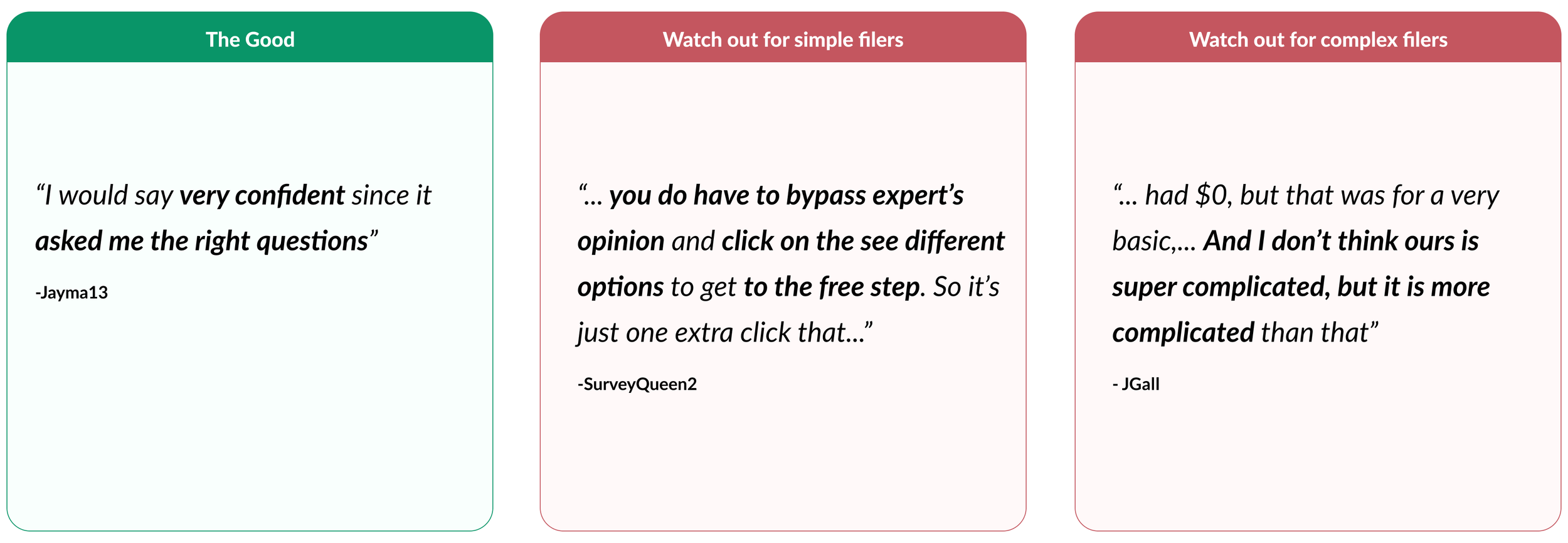
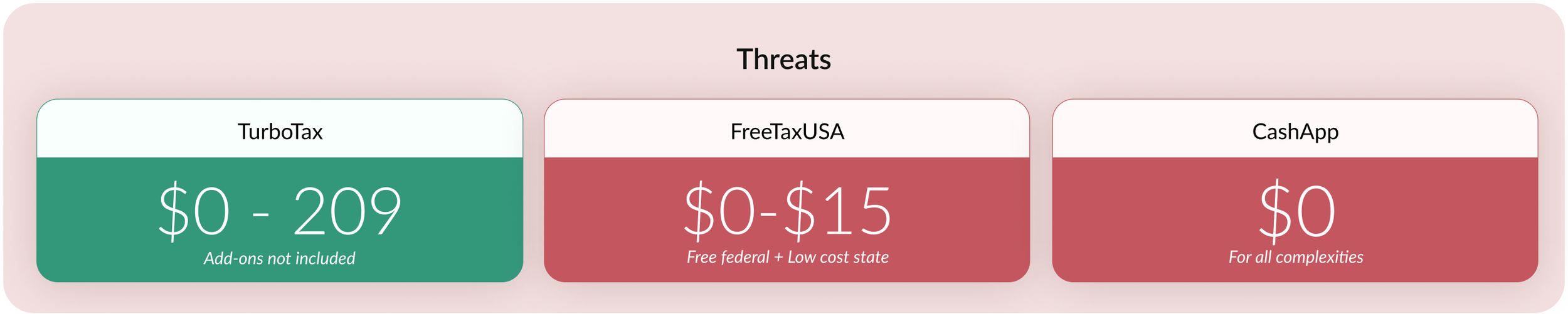
When looked into why filers were dropping off, price came up as the single biggest factor — more than half of abandoners cited it directly. The gap wasn't affordability. It was trust: filers didn't believe "free" applied to them, and they were actively comparing against competitors who advertise $0 filing with far less friction.
That competitive pressure was real. Free and low-cost alternatives were positioned as simpler, cheaper paths to the same outcome, which meant any hesitation at the pricing moment sent filers looking elsewhere rather than working through it. This reframed the problem for me — it wasn't enough to make the free offer available. The messaging itself needed to close the trust gap before a filer ever got to a price screen.
Strategic lever #3
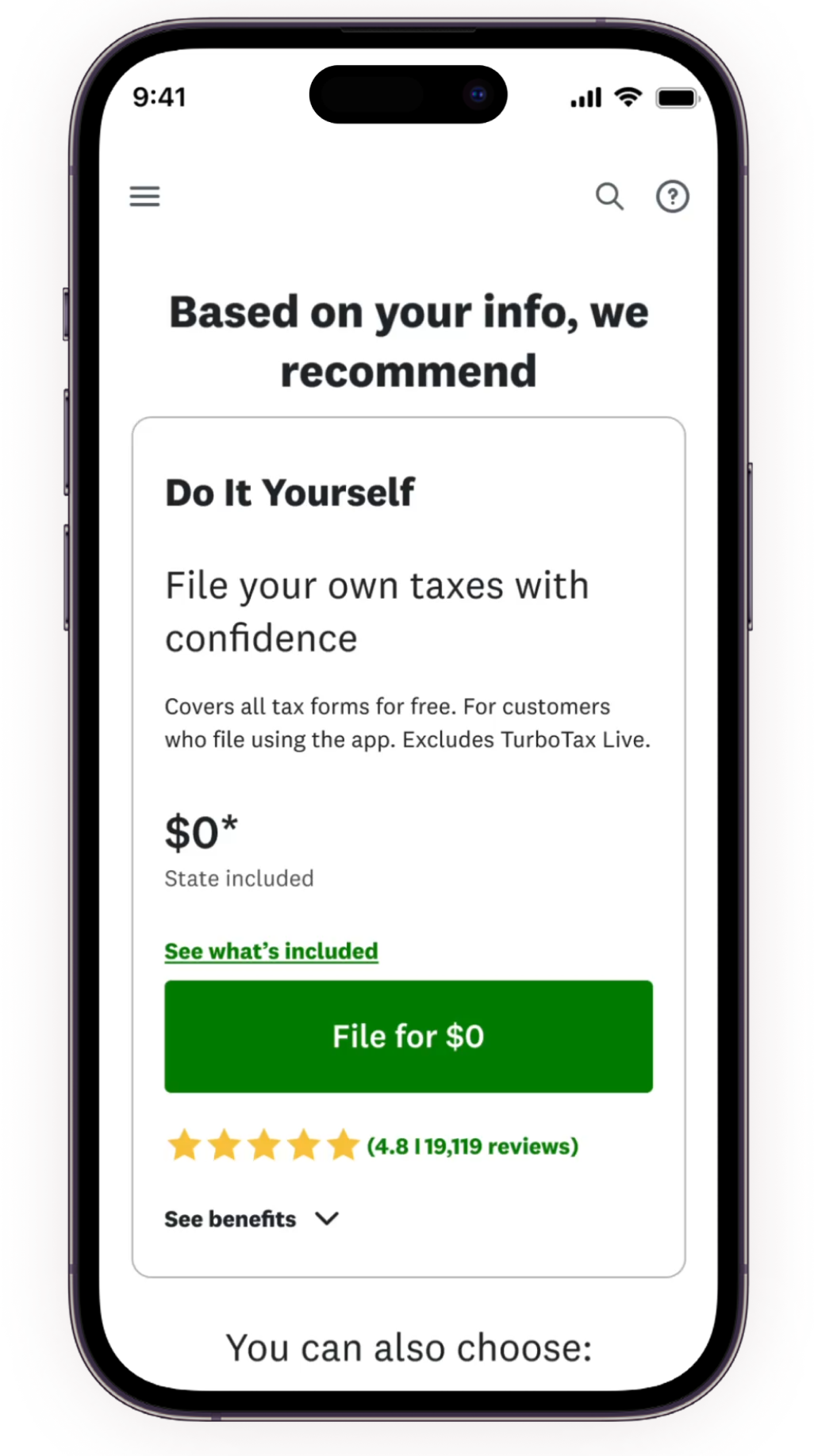
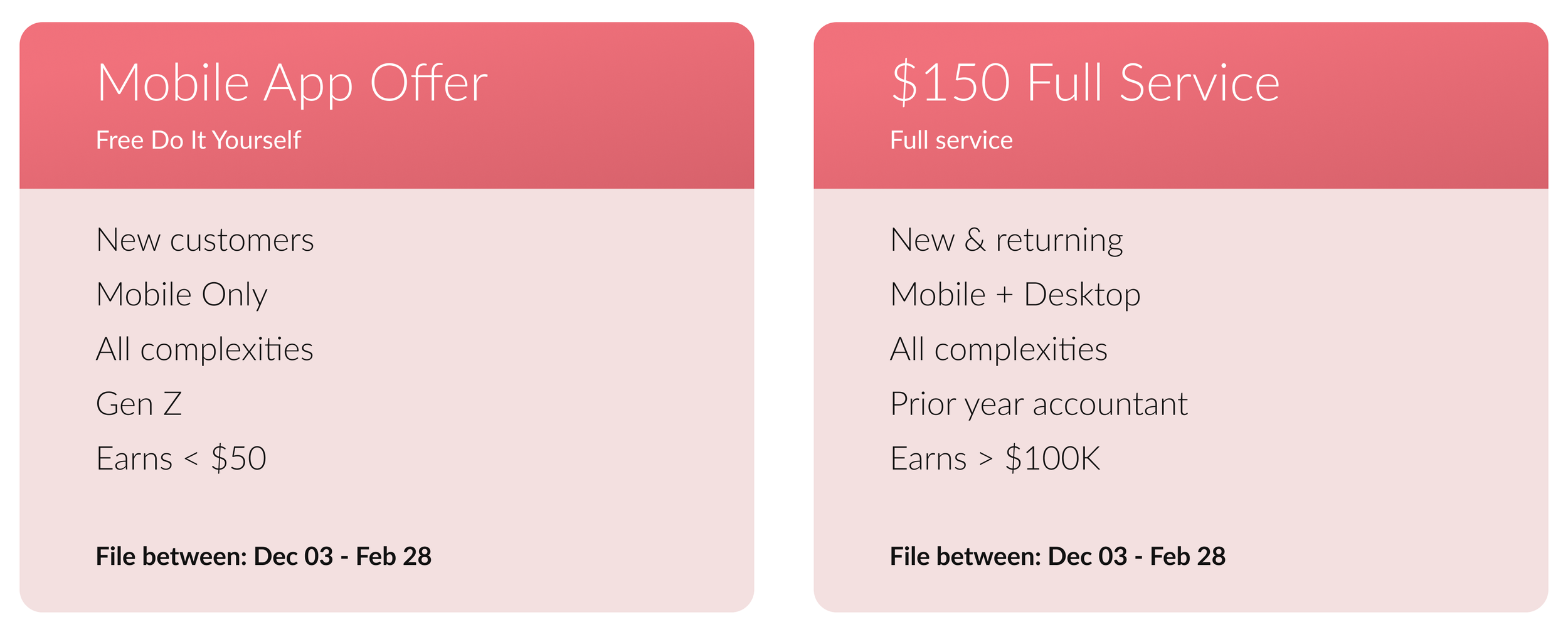
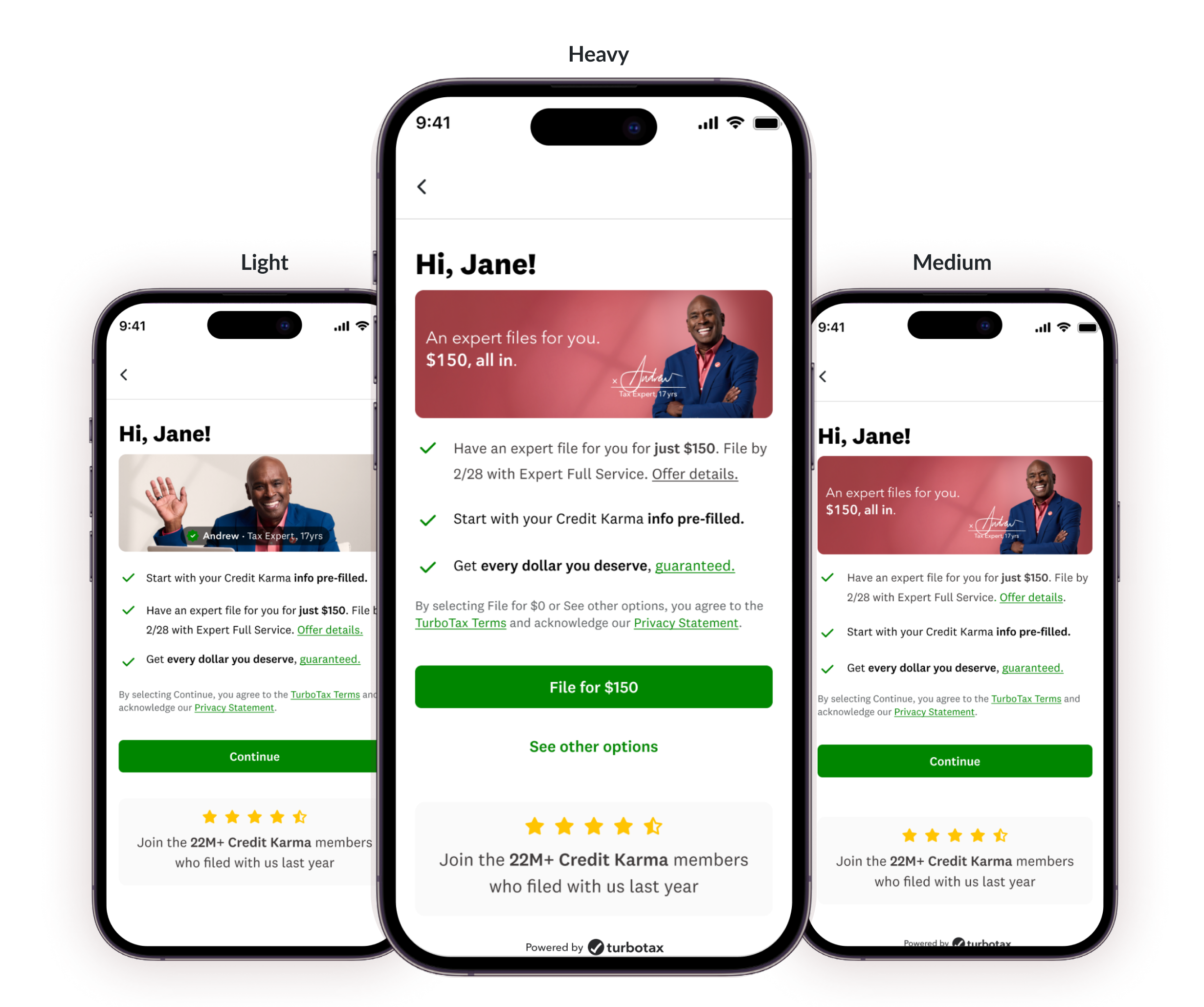
Since price was the top reason filers cited for abandoning, and Credit Karma members had never had access to TurboTax's actual offers before, I led the integration of two targeted promotions into the Credit Karma experience: a free do-it-yourself option aimed at new, lower-income mobile users, and a $150 full-service offer aimed at higher earners and returning filers who'd previously used an accountant.
Rather than one generic price message for everyone, this let the pricing match who the filer actually was and what they could realistically expect to pay — directly addressing the trust gap I'd identified as the core driver of price-related abandonment.
Customer Problem
Simple Filer Jane!
• Salary: 50K, Single W-2, Refund
• Target: with Mobile App Offer
I am a Credit Karma user considering filing taxes with Credit Karma to see if I can get a better refund,
but the price is higher than expected
because I'm used to paying way less.
Complex Filer Topher!
• Salary: 120K, Investments, Bal due
• Target: $150 Full Service
I am a Credit Karma user exploring a more affordable option, my accountant is too expensive
But I am not sure if Credit Karma handles complex tax situations
Because I assume this software is for simple filers and should stick to using my accountant.


Explorations
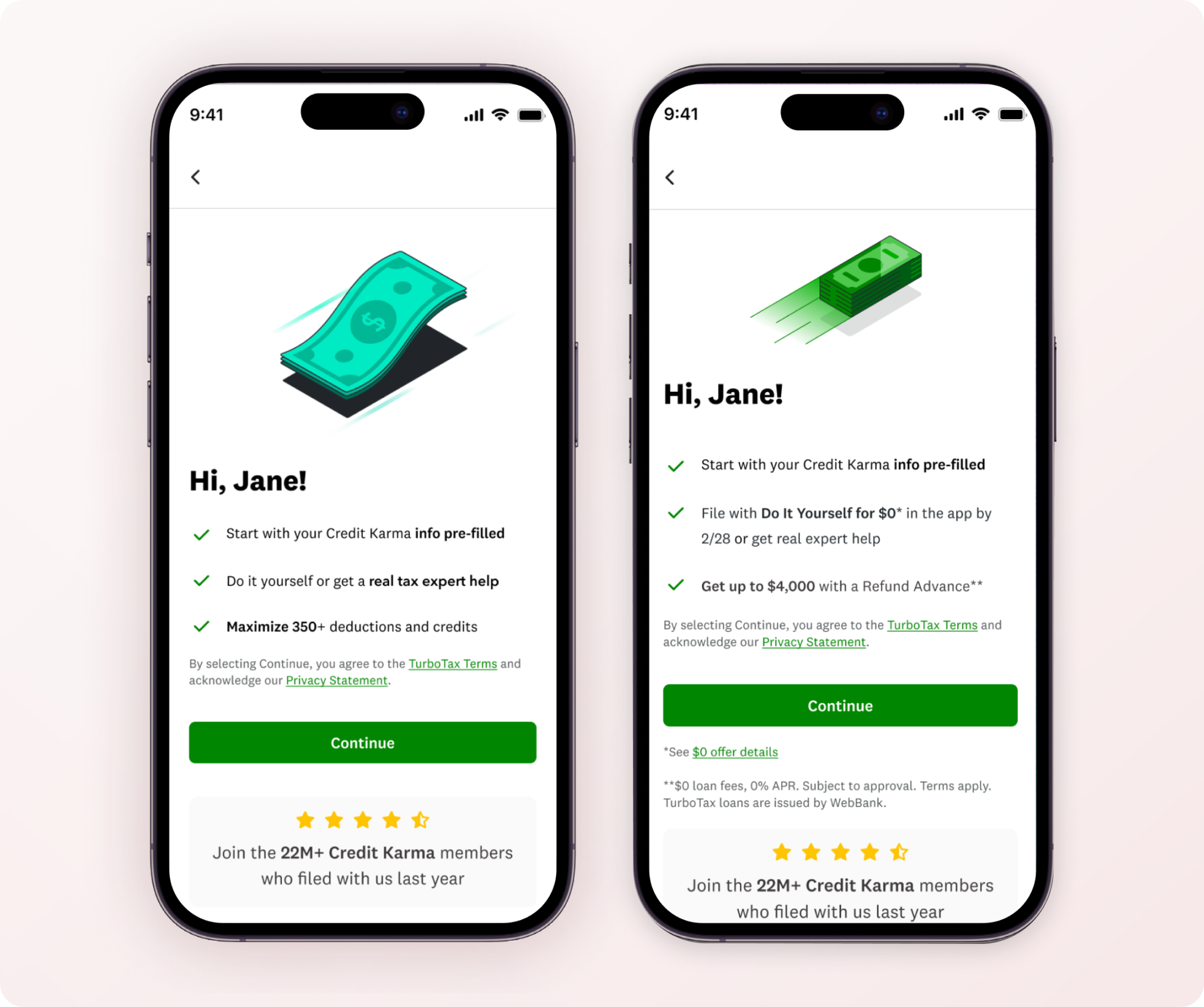
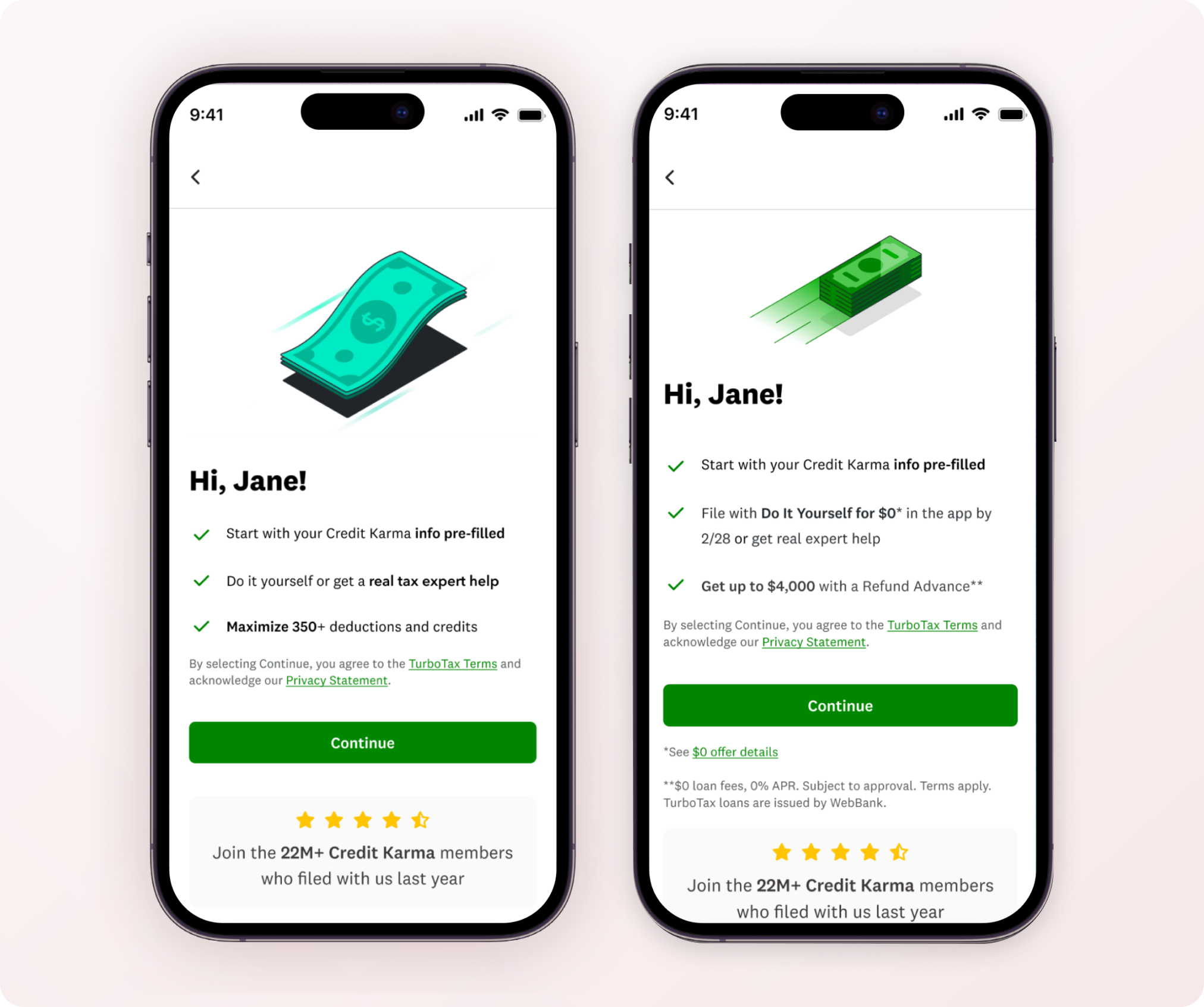
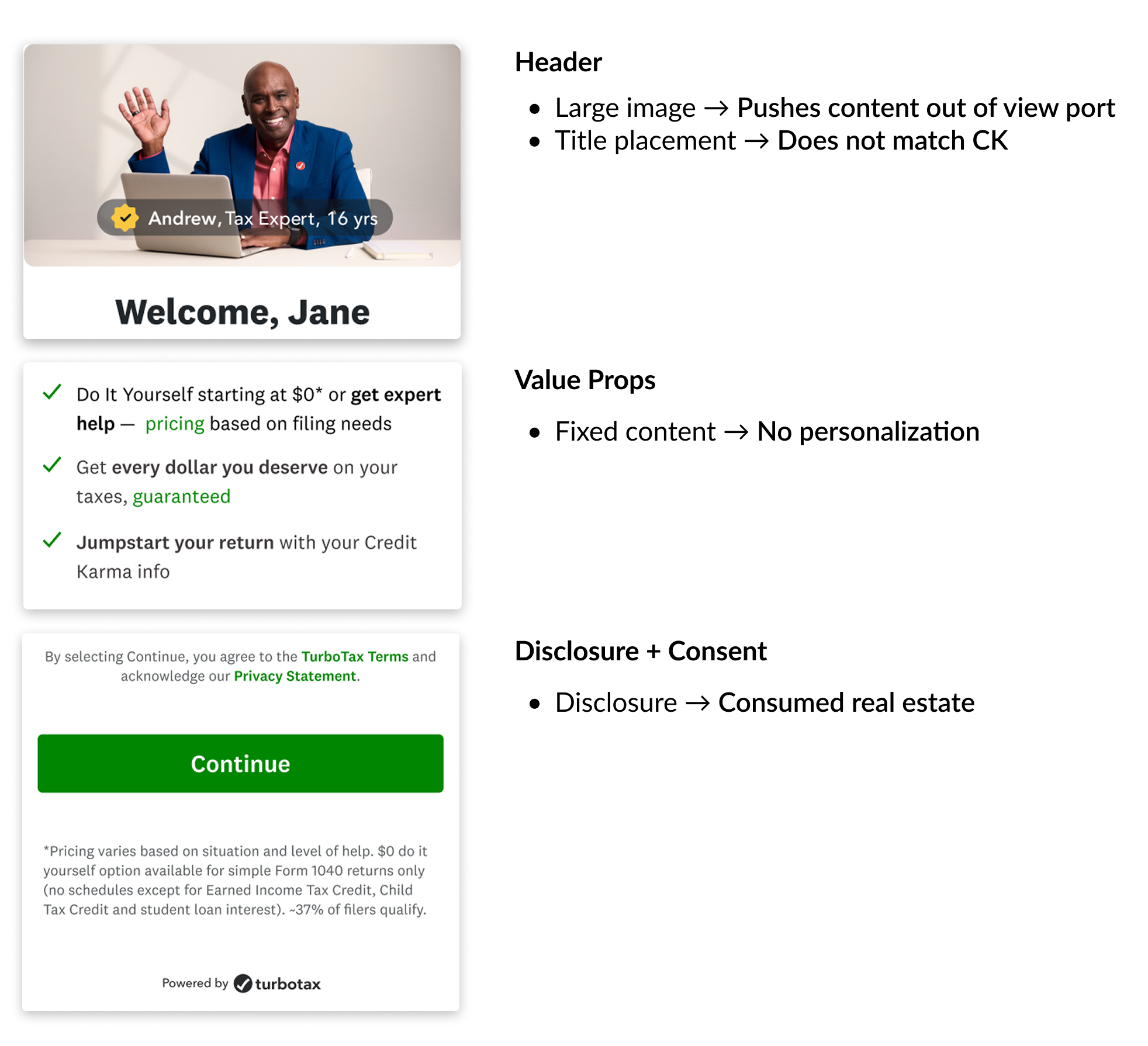
Current welcome
The baseline welcome screen showed every Credit Karma member the same generic message, regardless of who they were or what Credit Karma already knew about them — despite the fact that half of all welcome-screen visitors were still exploring, not ready to decide. The screen led with a name and a checklist of features, but was not targeted based on their needs.
That mismatch is what stood out in the data: the highest-volume drop-off point in the funnel was also the least personalized moment in the experience.
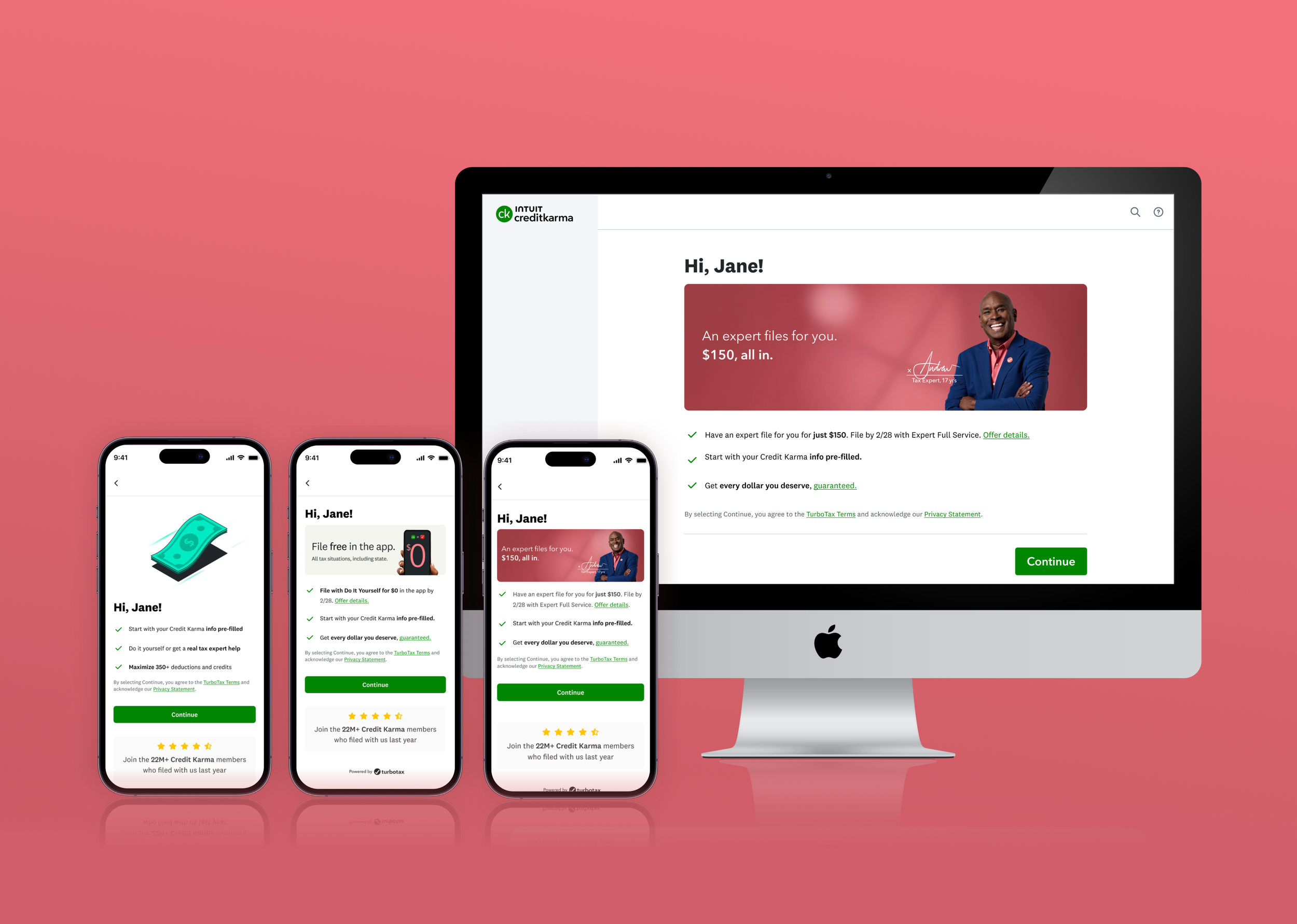
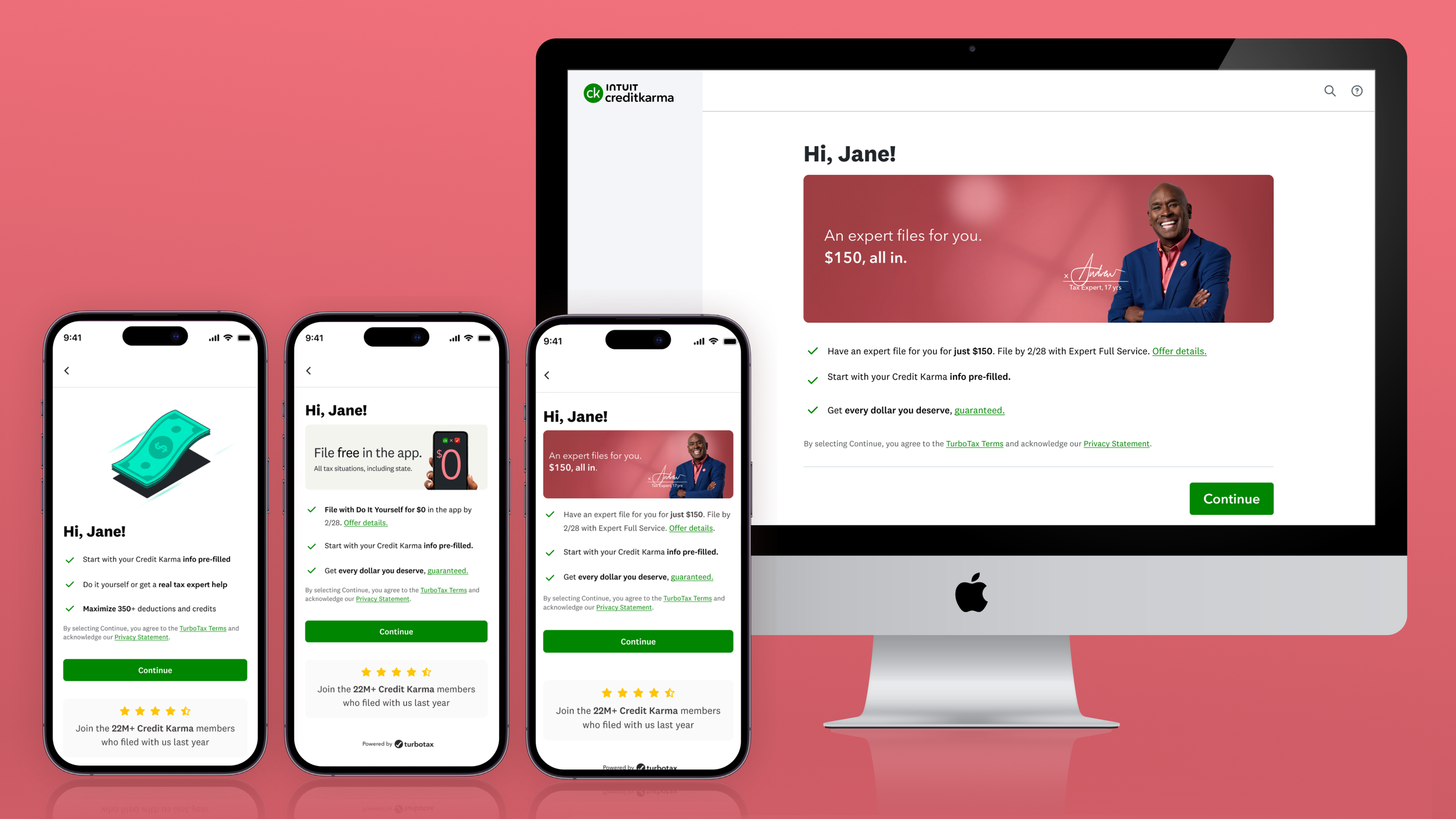
Final designs
Mobile App Offer
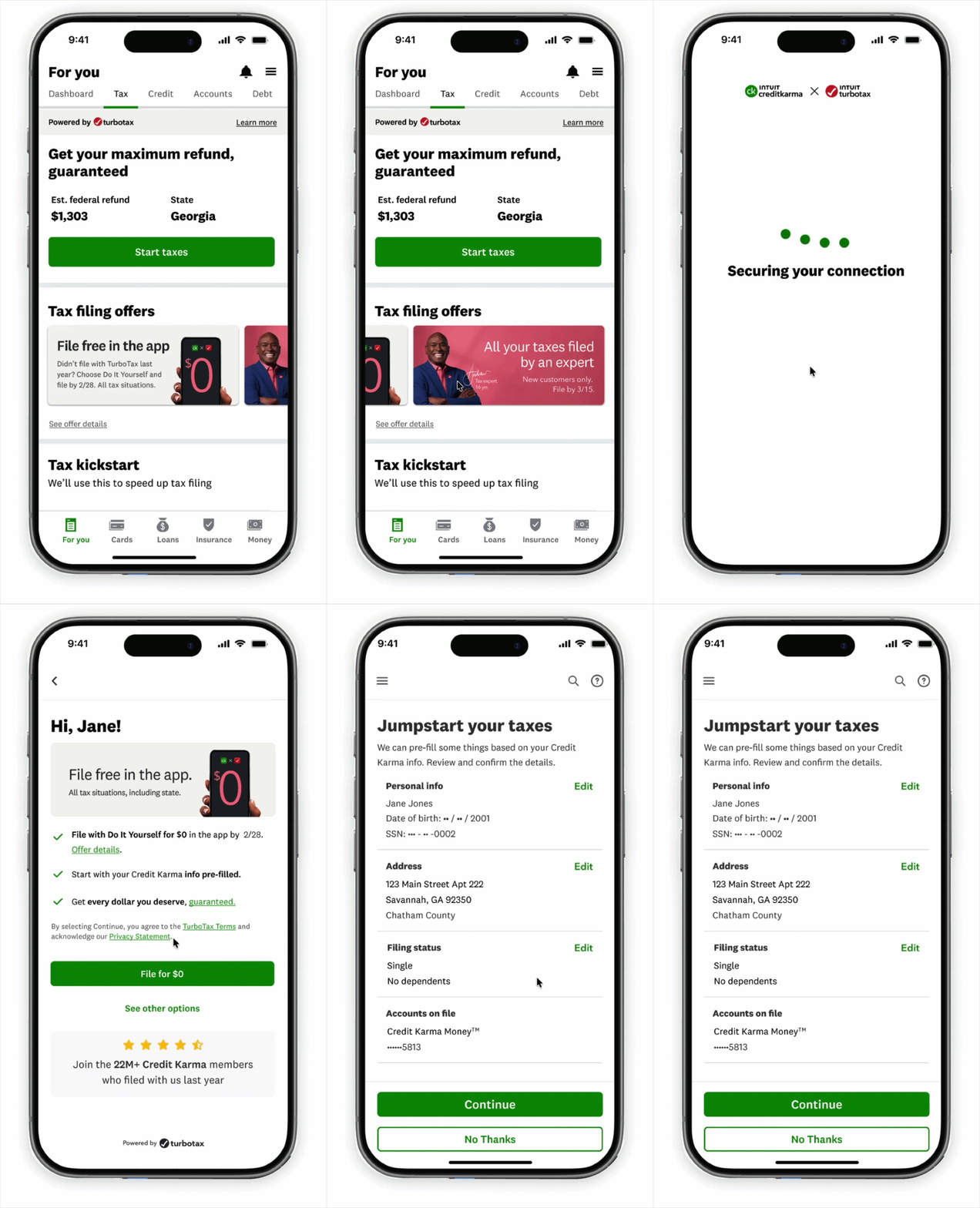
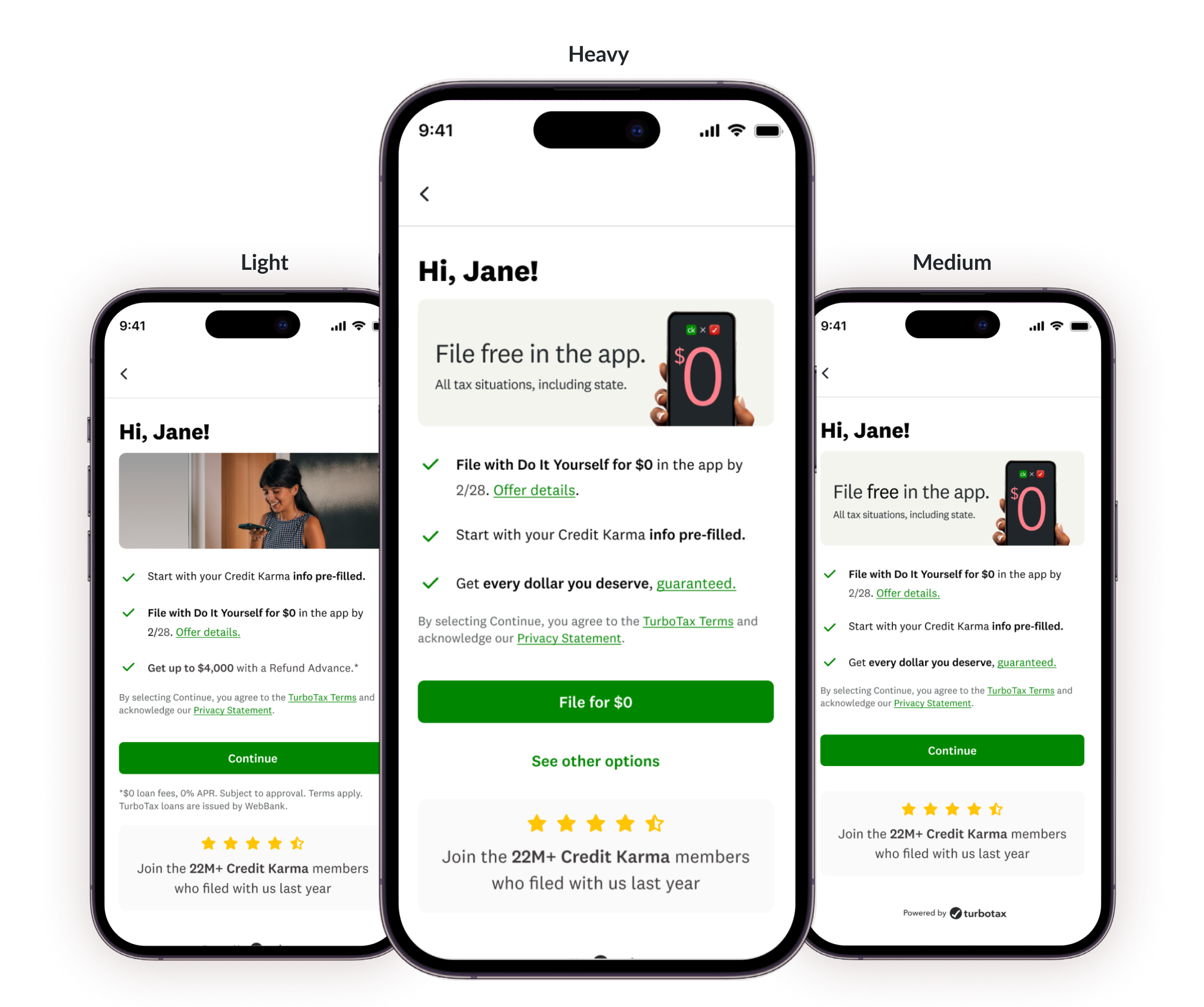
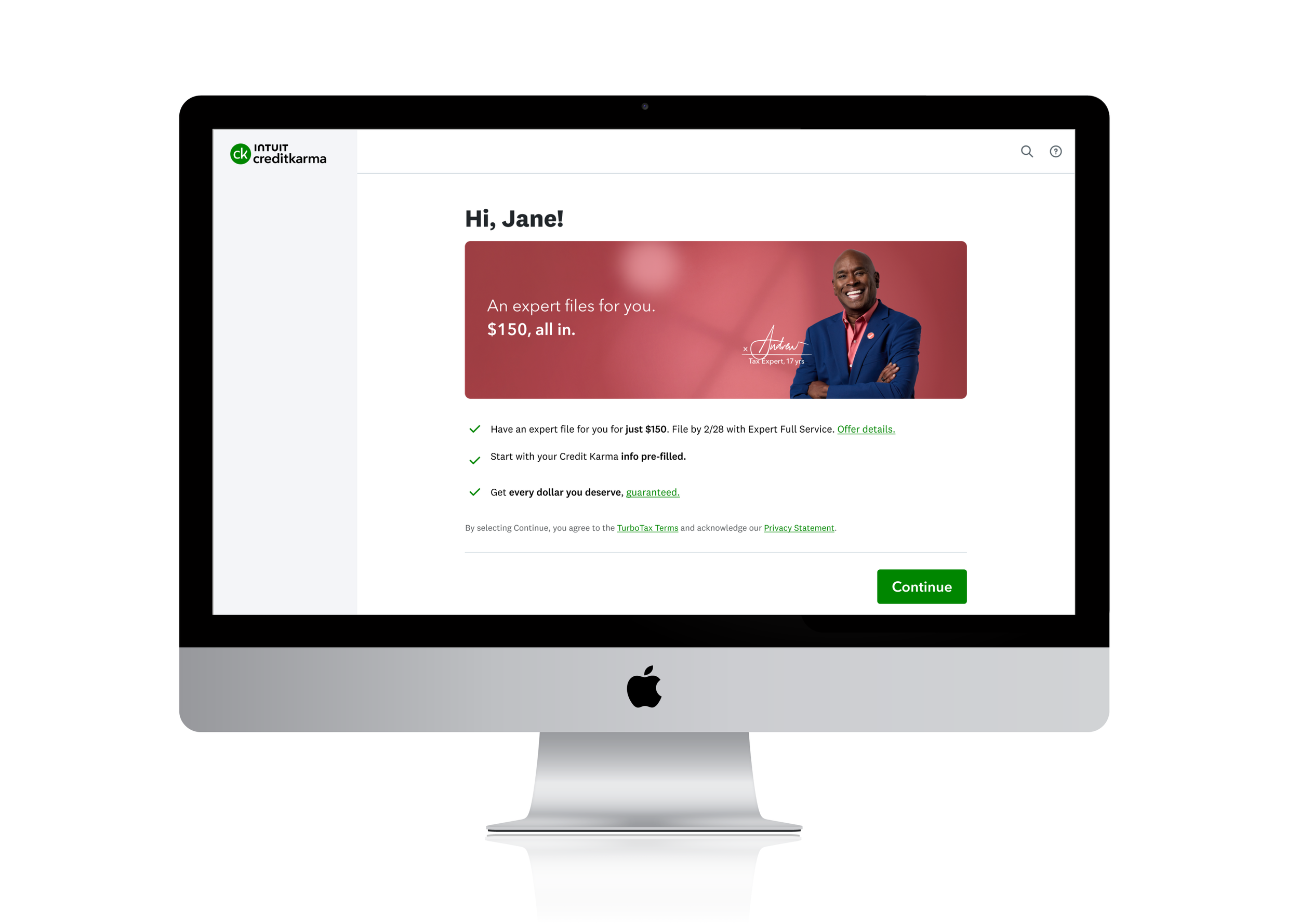
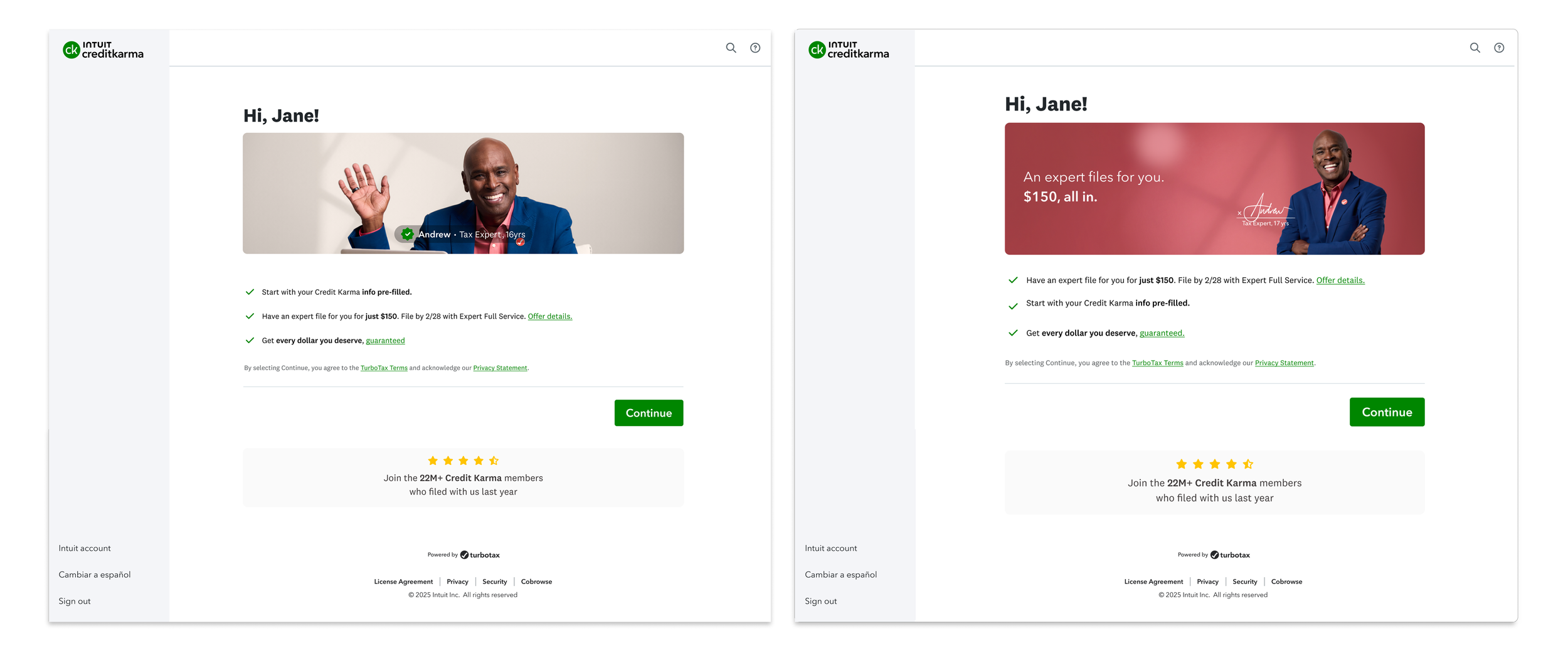
$150 Dollar Full Service Offer
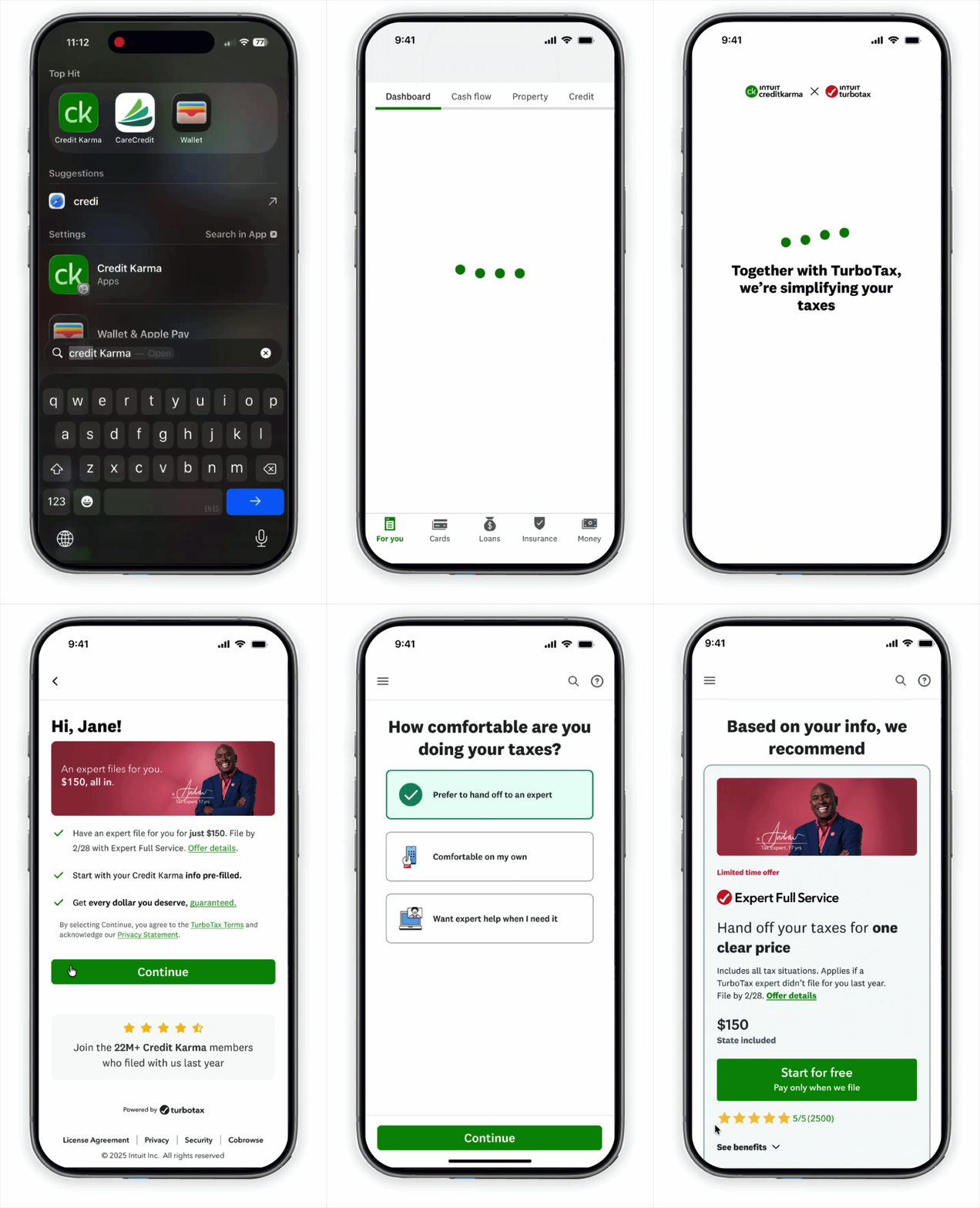
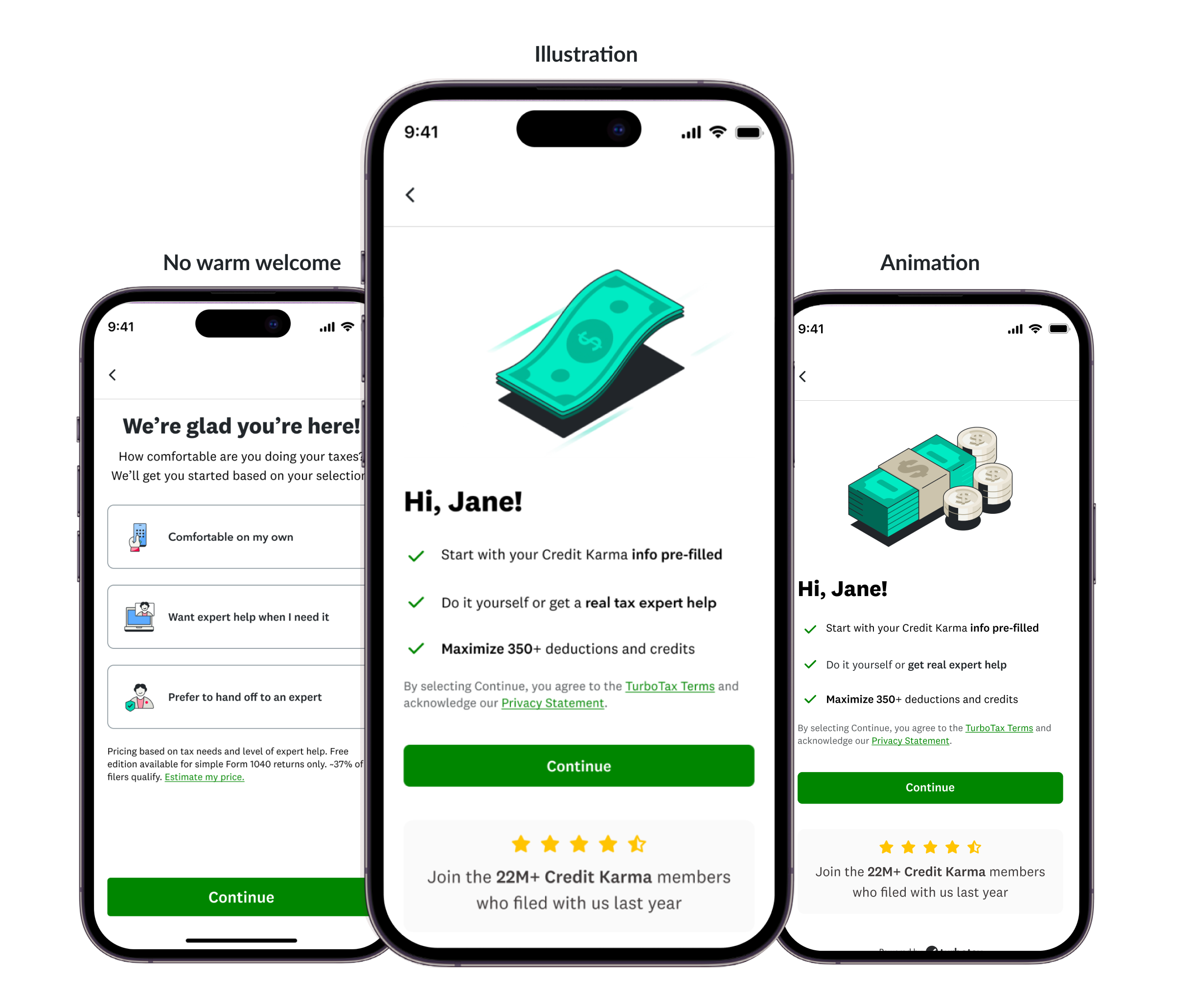
Generic - No offer - Outcome led
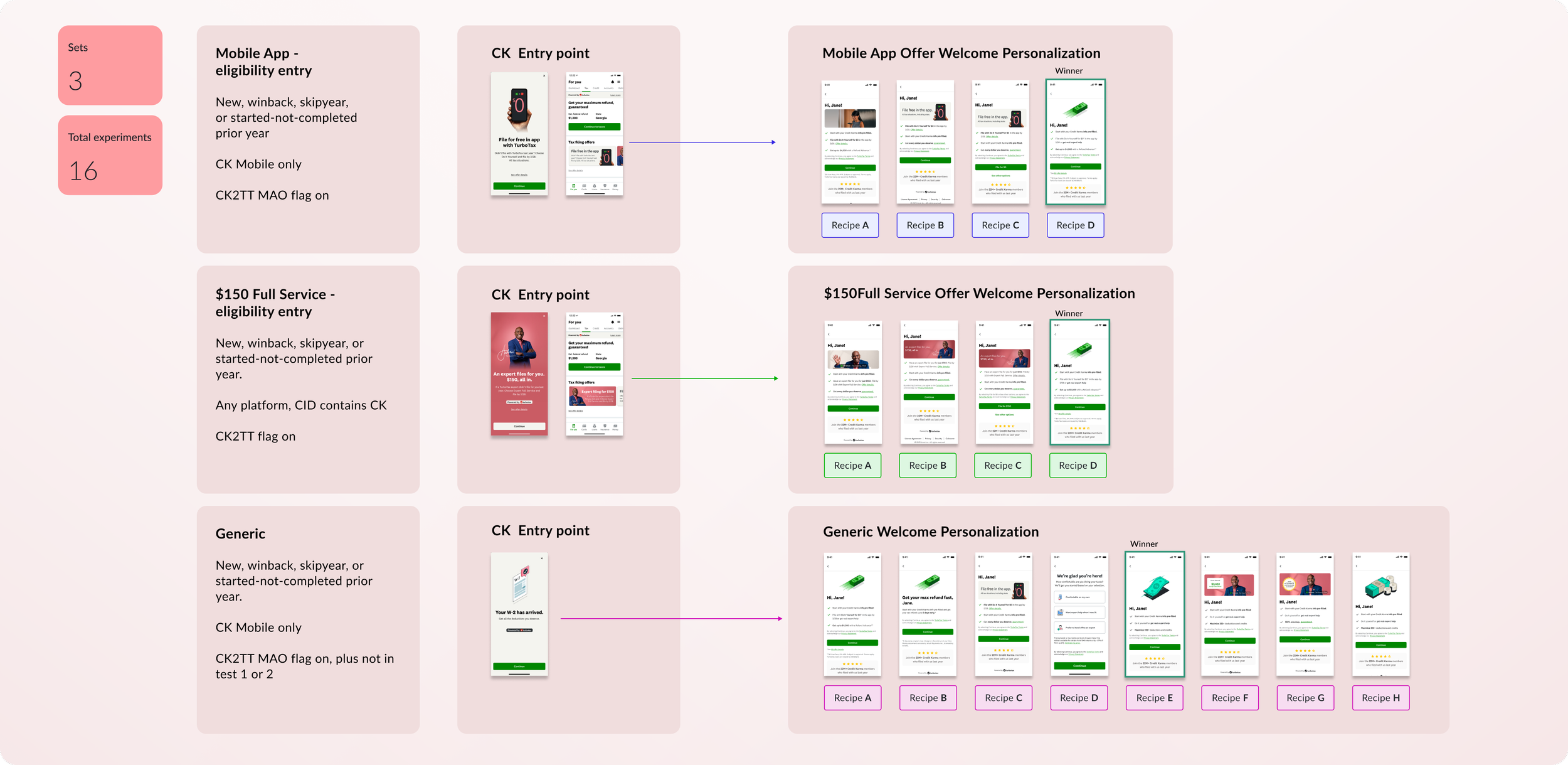
Experimentation plan
Weekly meetings
Each week, I met with our product manager, engineers, and data analyst to review how every welcome screen and onboarding sequence was performing. We looked at how many people started, how many finished, and how much revenue each version brought in. Based on that read, we decided together how much traffic each version should get: more to what was working, less to what wasn’t, and sometimes turning a version off entirely. [I brought the design perspective: what a result meant for the experience, and which new version to build next.] The result was a steady loop of testing, shifting traffic, and redesigning, rather than one big launch
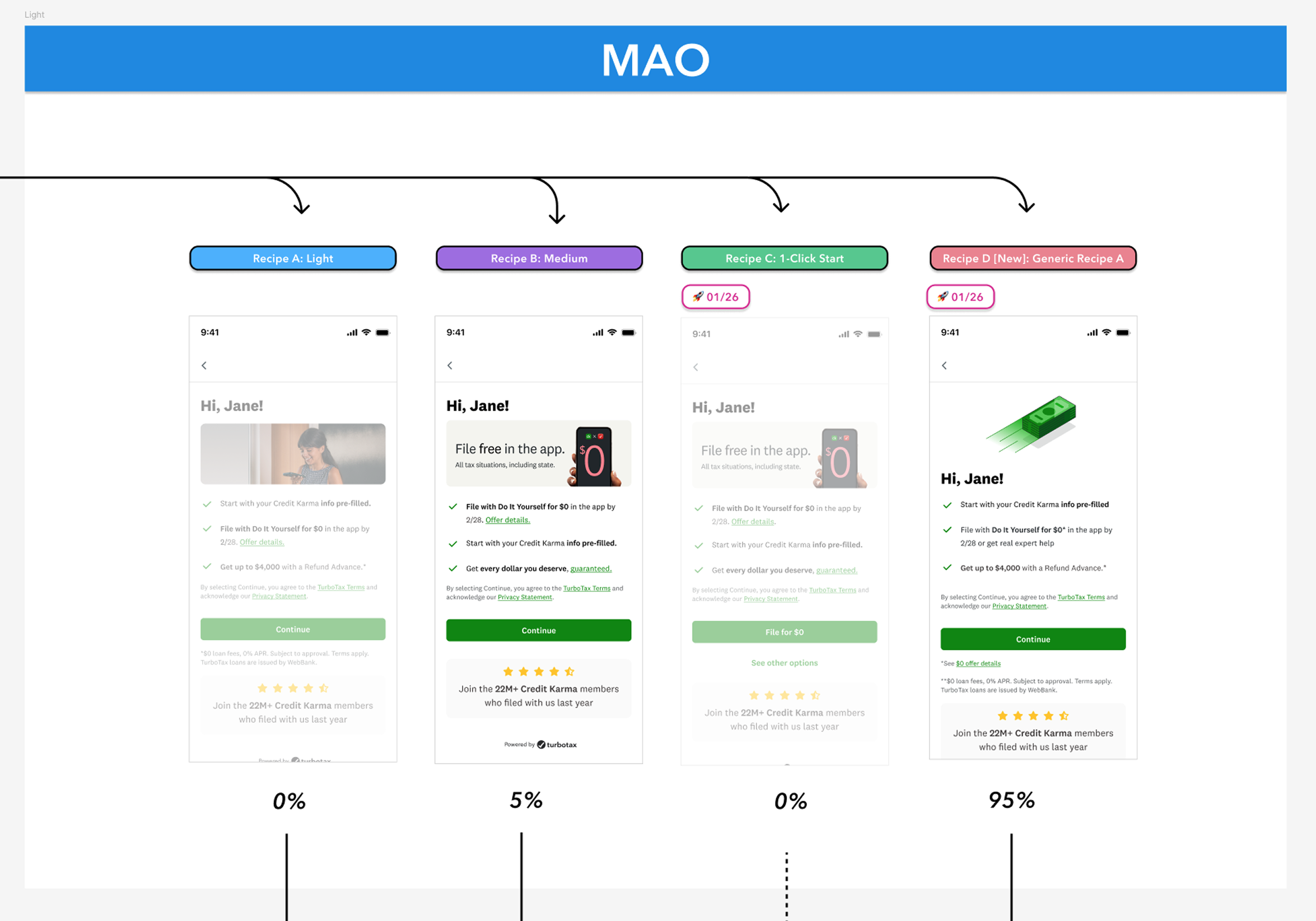
Winning recipe
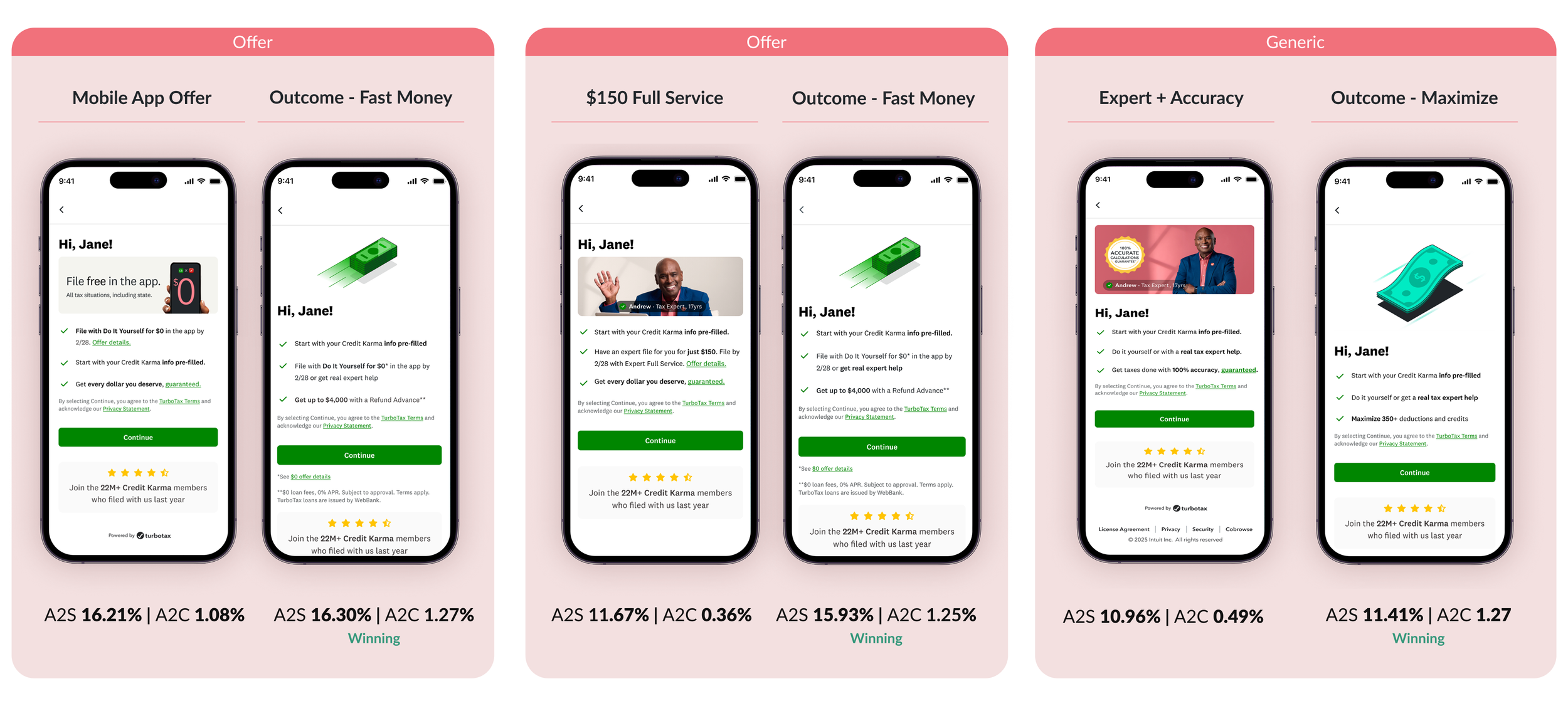
A2S: Authentication to Start (user engaged)
A2C: Authentication to Complete (User paid at the end)
AI Model vs. Rules based
(winning onboarding sequence from last year)
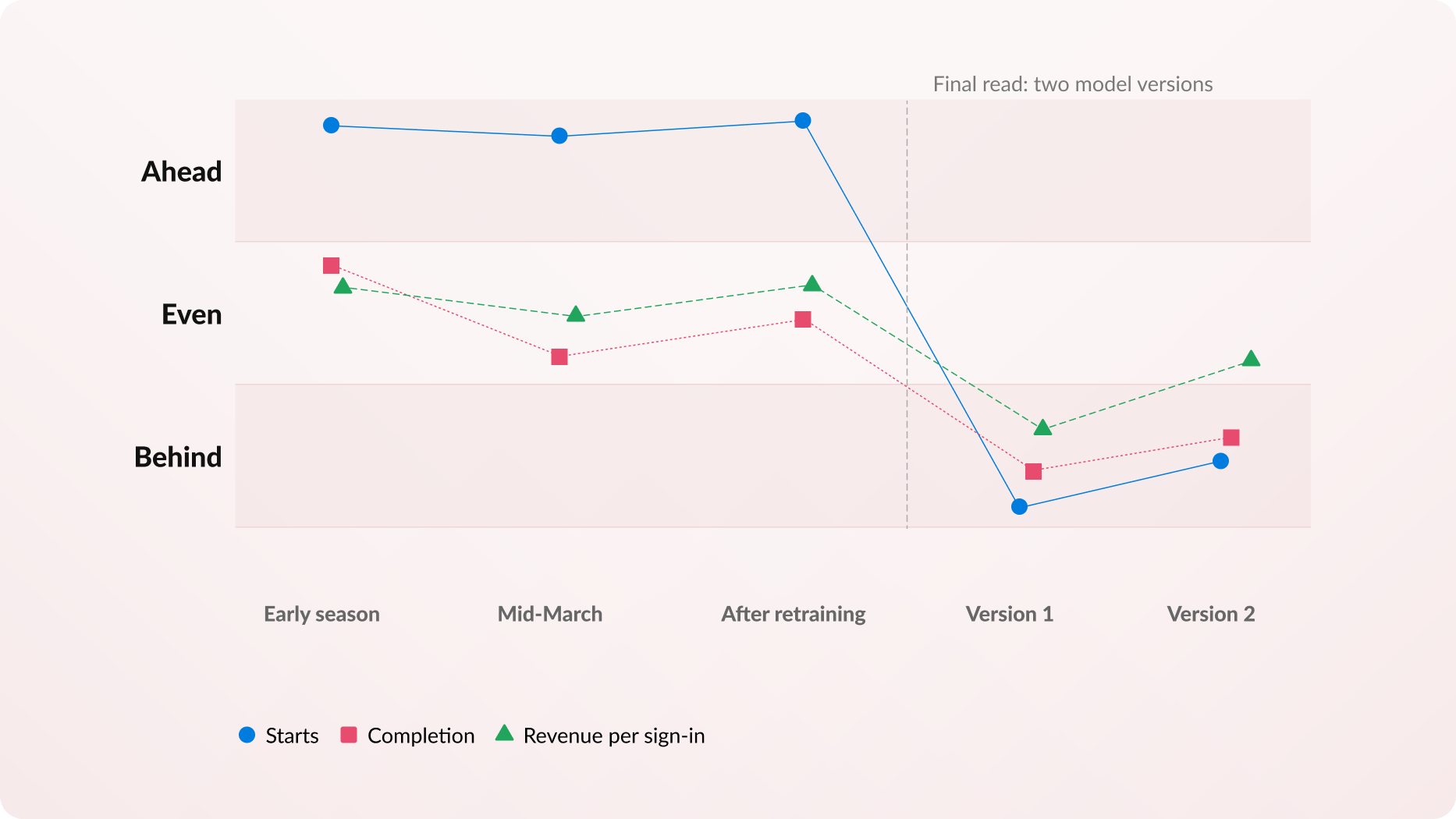
I tested an AI model that picks each person’s onboarding steps against last season’s rules-based approach. It brought in more starts for most of the season, but completions and revenue stayed roughly even at best, and the final tuned versions fell behind. On 4/1 the traffic split went from 80% rules-based and 20% AI mode to 100% for rules based.
Final outcome
I tested outcome-led messaging against offer-led messaging across three separate entry points — the general welcome flow, the mobile app offer, and a limited-time full-service promotion. In every case, leading with what filers would get out of finishing their taxes outperformed leading with the deal itself. That consistency told me this wasn't a lucky variant — it was a real pattern in how people decide to file. I used it to set the default experience across all three surfaces.
This work was part of a broader push that saw Credit Karma tax filers using TurboTax grow 54% year over year (Intuit, FY26 earnings).